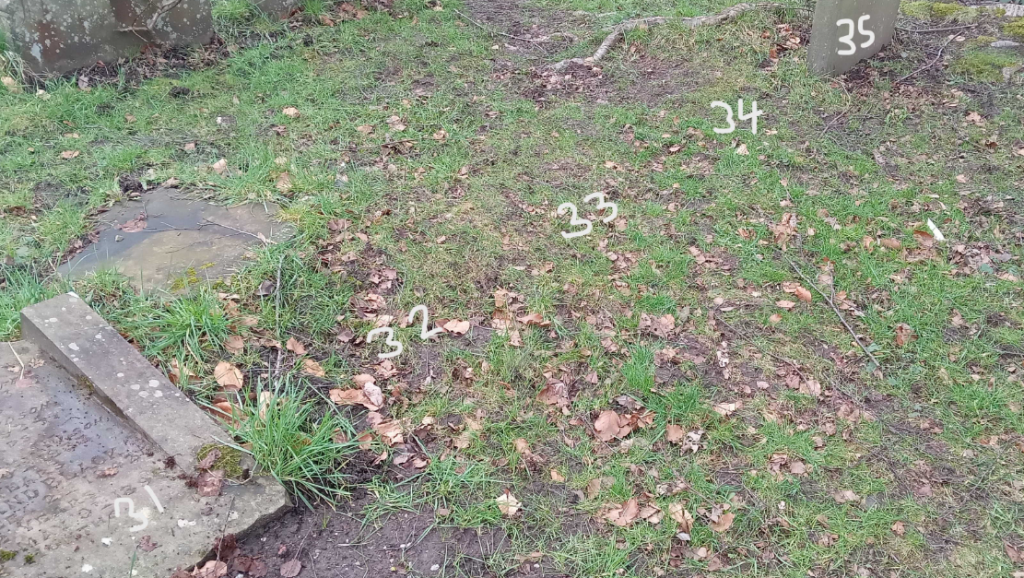
This grave piqued this researcher’s interest while writing up the story of Winifred Hogan, mainly because Mary here started her life as a Hogan. The TAS’s transcript knew about three of the four inhabitants here, and the fourth – Mary – is only a guess, but it seems like a realistic one. Where else would she have chosen to be?
Mary was born in Shropshire in 1859, a year before her future husband William Butterworth would be born here in Todmorden. Mary’s story is already partly told, so let’s look at William for the moment. William’s father John was a stonemason and William’s life started out at Bank Top, Honey Hole. John died in 1869 and his widow, Sarah Ann, was left taking in lodgers and working as a washerwoman to make ends meet for a few years before remarrying. Her new husband was William Ingham, also a stonemason and also a widower, and so William and his siblings gained a few more half-siblings as a result. William wasn’t interested in masonry and instead became a weaver. Mary had been working as a cotton drawing frame tenter, living on Albert Street, so whether they worked at the same location or not is unknown, but after their marriage in November 1881 Mary wouldn’t work at all.

The couple were married at St. Joseph’s as per Mary’s Irish Catholic traditions, and a few days over a year later their daughter Margaret Ann was born. Five more followed – May Agnes, Winifred, John, Lily, and Sarah Hannah. These last two children had short lives and while Lily’s (1893-1893) location is unknown, Sarah Hannah’s (1895-1896) location is. She was buried here on July 22nd 1896, between Jonathan Edward Horsfall on July 8th and John Edward Hazeltine on July 25th. Is Lily with her aunt Winifred? Or her grandfather John?
The Butterworths were first at East Street and then Meadow Street, and little is known apart from the possibility of William being a reservist who was called up in 1901, presumably to go to South Africa; would they have called up a 41 year old man though? The Boer Wars claimed appalling numbers of casualties but that high a number? Unfortunately we don’t have much else to say about their lives for a good spell.
One small detail is interesting, and oh if only everyone made this mistake! On the 1911 Census William misunderstood the instructions and wrote in everyone in the family, including the two now-married and out of the house daughters Margaret and Mary, and also the two lost daughters Lily and Sarah Hannah.

Before this decade was out there would be one more loss, that of Mary in 1919. Her death was taken hard by everyone, and the following year there would be not one, not two, but four in memoriams in the local papers – two per paper on February 27th 1920.
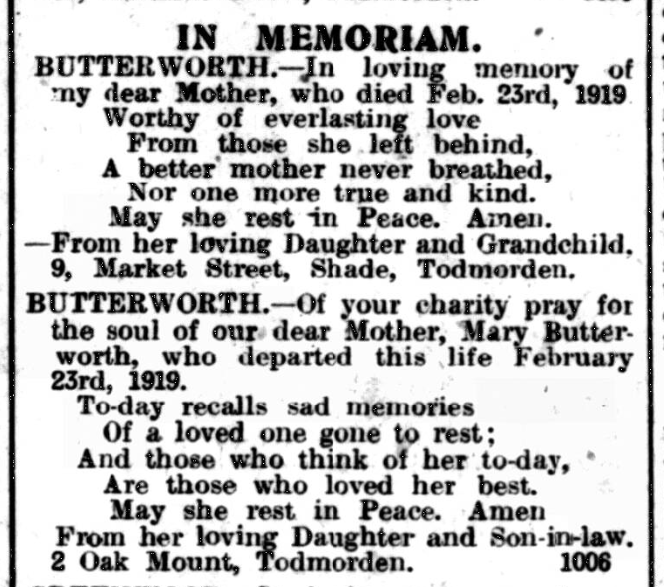
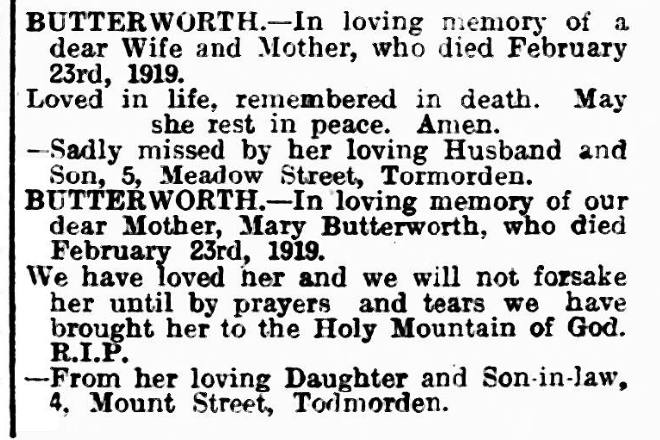
One from all the family appeared in 1921 and then that was that. The Butterworths held off on placing a stone because they knew more family would likely be buried here at some point, and they were right. By the 1921 Census it was just William and John left at 5 Meadow Street, and both were worryingly out of work. William and John both had what would later be termed “indifferent health” and this might have been the start of it…or perhaps Mary and the daughters carried more weight around the house than either man realised, and their previously not too troublesome health was suddenly more of an issue when they had more household tasks to carry out themselves? Either way, both men did eventually find work again, but William particularly struggled on and off from this point forward.
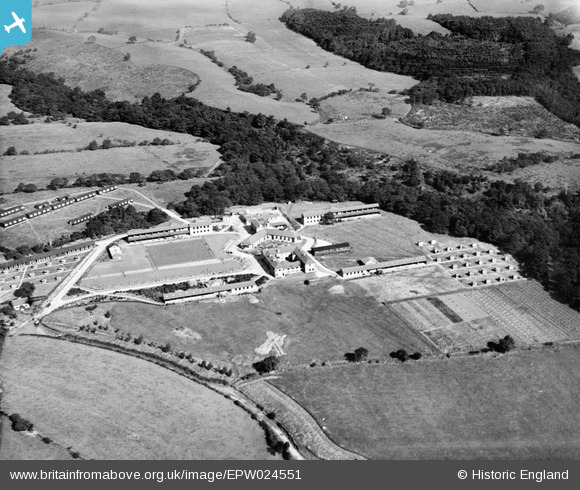
Unfortunately John would be the next one into the grave here that we can be sure of, and that came in 1932. John had been a leather worker on and off and it’s possible that he was one of the untold millions who developed tuberculosis as a result of exposure to infected cattle and their body parts. If he was dealing with carcasses and unfinished leather then it was very likely indeed. He and Williamhad been living just a few doors down from Margaret and her husband John Allister on Halifax Road but he ended up going to Middleton Sanatorium in Ilkley to try and find some relief from his symptoms if not an outright cure. No cure was forthcoming and relief came only with death, unfortunately, and he was brought back here to be buried.
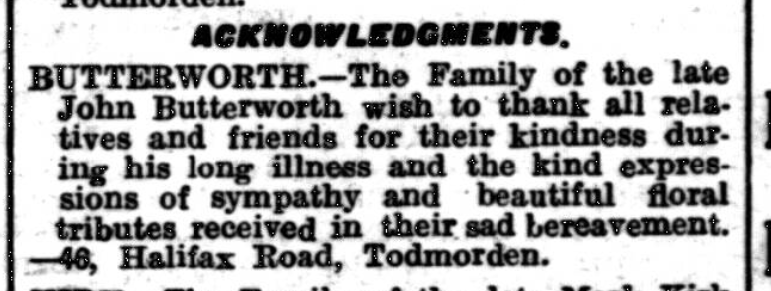
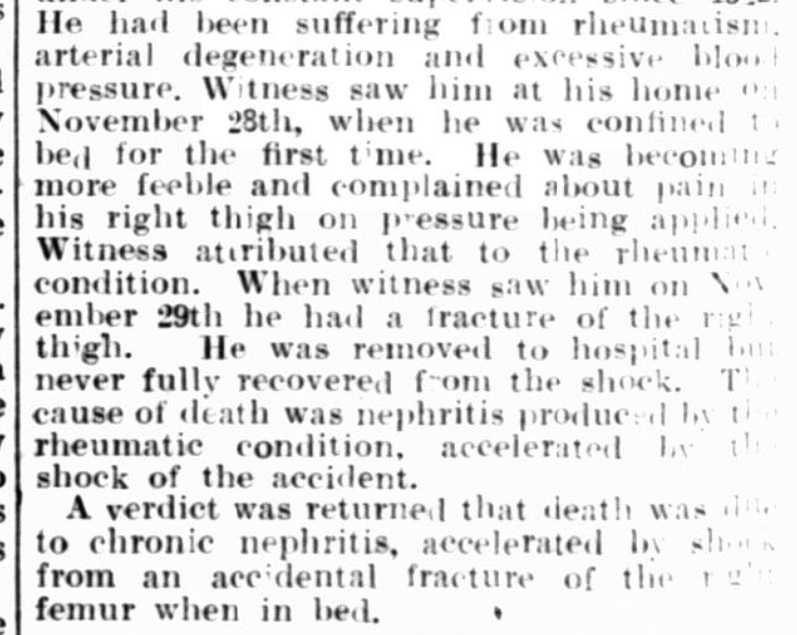
Now William was on his own and had to move in with the Allisters, and his rheumatism became so bad that he needed frequent visits from Dr. Thorp. He was also suffering from arterial degeneration and very high blood pressure…an extremely unwell man. Again, how much was John carrying him? Was William devastated by his losses so much that physical and emotional distress became linked and his entire body began to shut down? On his death in 1935 from complications following fracturing his thigh while in bed (?) an inquest was held that revealed a picture of a very ill man, in a lot of pain, needing much help, and who was probably glad at the very end to no longer suffer.
It’s a shame that a stone could never be placed here to commemorate the four Butterworths who we are sure (or near as damnit) are buried in this plot, but maybe one day a descendant will do something about it.