This little plot marker hides a big secret…in more ways than one! Read to the end for a twist in this explorer’s tale.
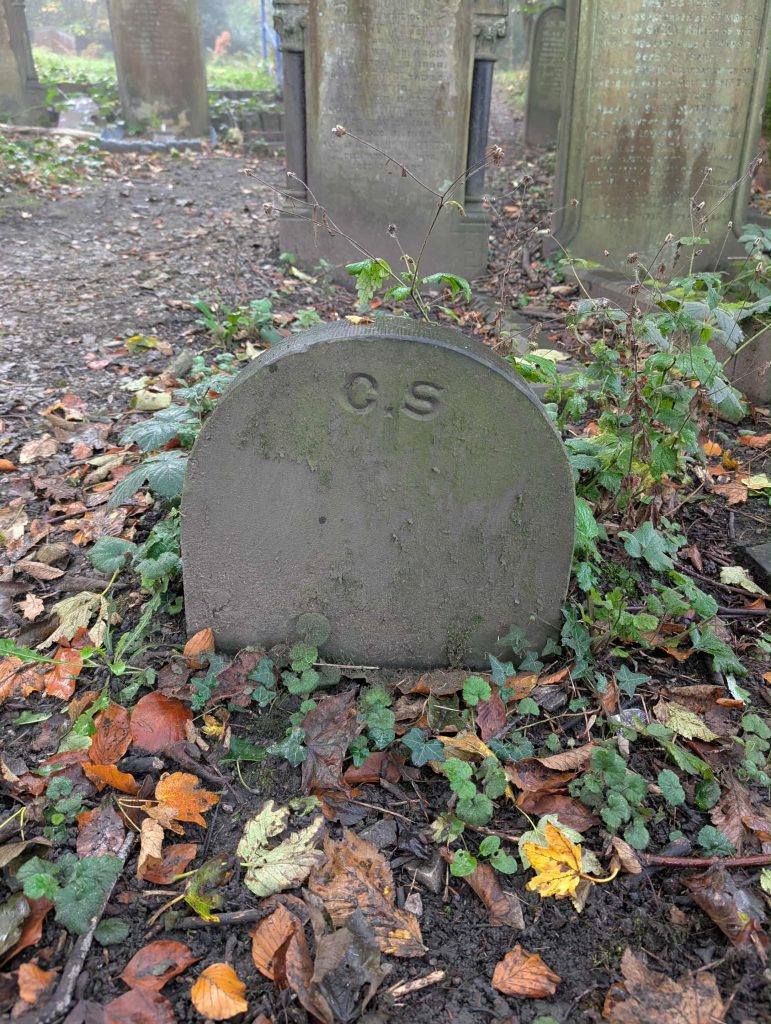
The story begins with James Sims, who was born in 1816 in Penryn, Cornwall. Penryn is just to the east of Falmouth on the south coast and a quick look at a map gives you an ample clue as to what James’s career would turn out to be. His father John was a sea captain so that makes it even less of a surprise! Even though James initially apprenticed as a shoemaker he quickly realised that boot leather wasn’t his bag, and in 1835 he joined the Royal Marines as a private 3rd class and started his life on the sea. He had plenty of time off the sea, though, and in April 1839 he married Maria Pryn in Plymouth before starting a stint on the HMS San Josef, which was stationed at Plymouth and being used as a gunnery school.

Maria was a year younger than James and had been born in Saint Germans near Plymouth, so was herself no stranger to the sea. She was one of fourteen children of the very energetic and very tired – you choose who was who – butcher William and his wife Grace. Despite James’s long absences he was home long enough to give Maria a more sensible number of children. They had four together over the course of sixteen years: William in 1840 (and who died in 1844), Emma in 1842, Thomas in 1844, Charles in 1852 and Emma Maria (named for the first Emma,who died in 1854) in 1855.
James’s service was marked by one particular high point: in 1848, the first search parties were sent to the Arctic to try and find the lost expedition headed up by Sir John Franklin, and James was a crew member on one of the four Royal Navy ships enlisted – HMS Intrepid, Resolute, Investigator or Enterprise, we know not which one. He would tell stories of their travels for the rest of his days.
James retired from the Marines “by his own request” with the rank of Corporal in 1858, moved to Lower Clicker six miles from the coast, and became a Greenwich Pensioner – like a Chelsea Pensioner, but for sailors. This would be his given census occupation for the rest of his days so it’s reasonable to think that his years on the seas damaged his health. Now he was home with Maria and his three remaining children, and with a small pension of £38 for his 22 years of service with the Marines. We say meaningful because it wasn’t until a year after his retirement that pensions became automatic – before then you almost always had to be injured in the line of duty or while on service, according to the National Archives, so James’s four good Marks and lack of appearance in the “book of defaulters” (naughty sailors) as well as some sort of injury or illness will have contributed to this.
Charles is the son whose life journey is the link between Cornwall and Todmorden, and that came about because he made different choices than his father and grandfather had. Whether he didn’t fancy the seafaring life despite the adventures he heard about, or whether his mother simply would not allow it, he didn’t become a sailor. He also didn’t become a lead miner like Thomas. Instead he moved in with his uncle Richard Pengelly in Saint Germans and apprenticed with him as a shoe and boot maker. He did well and in late 1872 he married Emily Ann Hosking, and the couple quickly dashed up north to Todmorden just in time for their first daughter Emma Maria’s birth in January 1873. His sister Emma Maria, who that daughter was named for, came with them. Next came Rosina, named for Emily’s youngest sister, and then came Amelia in 1877. In 1878 William Henry was born…but little Rosina died, and she was buried with sadness in a plot towards the back of Christ Church on September 12th, with C. S. engraved on it to show the plot belonged to Charles.

Amongst the mourners would have been her grandparents, because at some point James and Maria also made the move to Todmorden. If James was unable to work regularly due to his health then this would have made perfect sense; Thomas had gone to America at this point with his wife and would not return, and all the rest of their children were heading north too, so why not join them? No one who stood at the graveside then could have guessed that the grave would be opened again soon, this time for Maria, who died in January 1879.

Charles and Emma had been in Tod for a few years now, and one wonders whether everyone was prepared for their accents – Charles’s daughter Amelia’s baptism register entry gives his occupation as “cord-winder” rather than cordwainer; a pronunciation issue? – and one wonders whether they were prepared for Todmorden’s weather, people, general environment…maybe losing a child and then a parent soured them on the place. James might not have helped either, accidentally. Let’s not remember that James wasn’t able to work, and losing his wife meant losing his partner but also his helper. In July 1879 he fixed that problem by marrying a Cornish widow, Elizabeth (Roberts) Jeffreys Tremeer. She was twenty one years his junior. Whether this quick turnaround bothered Charles or not we don’t know, but he and Emily took their other children, and Emma and her husband Frank Penwarden took theirs, and both families left for London to never return.
Elizabeth moved into James’s home on 19 Wilson Street in Millwood along with her three unmarried daughters, and the couple stayed for a few years but in early 1885 decided to move on to somewhere new. They settled on Barrowford near Nelson where James went back to work to supplement their income. They were only there a few months before James died, from “sciatica etc.”, very helpful there thank you doctor, and he is buried here at Christ Church, so we like to think that Elizabeth did the right thing by him and made sure he was buried with Maria and Rosina – with Charles’s consent of course. Whatever possible bad feeling there might have been was suspended.

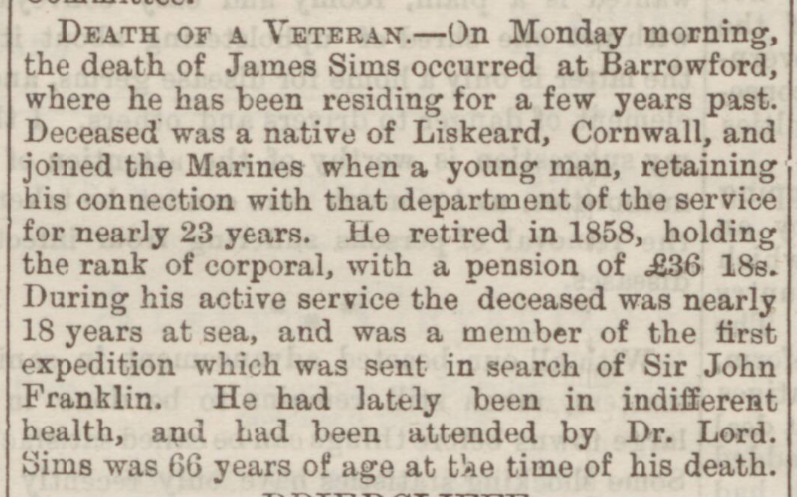
James must have told Elizabeth the same stories he told everyone else about his time in the Arctic, because his obituary gets straight to the point: here was a man of action and adventure, who for all his other flaws would have some cracking stories to tell. The rescue expeditions themselves were mired in danger and difficulties, there were four of them all told after all! And when the researchers got hold of those obituaries they were thrilled and went all out trying to find out more about his role on the expedition. Which ship was he on, was he still a private 3rd class, was this how he became a corporal? We were also intrigued by a mention of an account written of the first two rescue expeditions in which the writer (one of the captains) was “scathing” about the men who he had under him. Gossip?!? So off we went to the National Archives website to see what information we could drag from their storerooms…
Well.
James, you naughty boy, you never went to the Arctic at all.
Royal Marines were promoted based on length of service rather than merit, like the Royal Navy, and so James’s rise to Corporal in September 1851 was a result of him having 16 years of service under his belt, both on and off the sea. Let’s look at his naval record shall we?
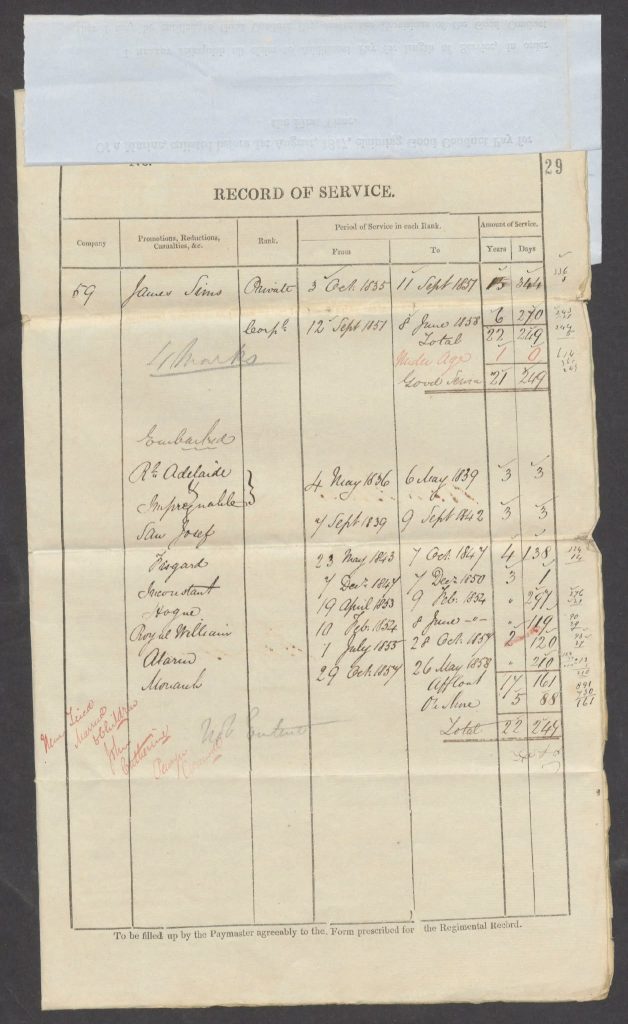
This website very handily allows you to see where any HMS ship was at any point during Victorian times, and comparing it to his record, we can see that James spent the entirety of his off-shore service just off of Plymouth, or in the Pacific, or travelling up and down the coast of the Americas. An intriguing on-shore gap of 2.5 years might tempt us to think that perhaps he took on other work, but his on-shore time is counted towards his pensionable length of service and so it doesn’t seem likely he would have been permitted it. Anyway, he was present at home for the 1851 Census in March, would probably not have been away when made a Corporal in September 1851, and he definitely needed to be on British soil in January or February 1852 because that’s when Charles was conceived (otherwise Maria would have some questions to answer). That leaves a much shorter time in which to go to the North Pole, during a time when it was almost entirely Royal Naval vessels going so would have shown on his record, and with a large amount of competition from other seaman eager to go, and with no experience at all of sailing in Arctic conditions…you get the picture.
Lastly, on-shore time was spent at barracks training or being ready to defend, and on the 1851 Census James was living at Narkurs with his family and father-in-law. It may have been that he was recovering from some sort of illness after his return from sea on December 7th 1850, rather than on actual extended leave of a few years in which to do as he pleased. It would explain his permanent pension later and status as a Greenwich Pensioner.
James had a sterling conduct record though which begs the question of when he started to tell this story, and why. It can’t have gotten traction while he lived in St. German and Liskeard, so must have come about in Todmorden. His children could conceivably claim ignorance and have believed it, but Maria would have known. Was it a story he told after her death? Was he trying to impress Elizabeth? Did he tell her during courting or after his adult children had left for London? She certainly believed it and was proud of his service and keen to let the world know. Maybe it’s for the best that Charles never put a stone up because she would have pressed for the story to be engraved on it.
Maybe that’s why Charles never put a stone up?
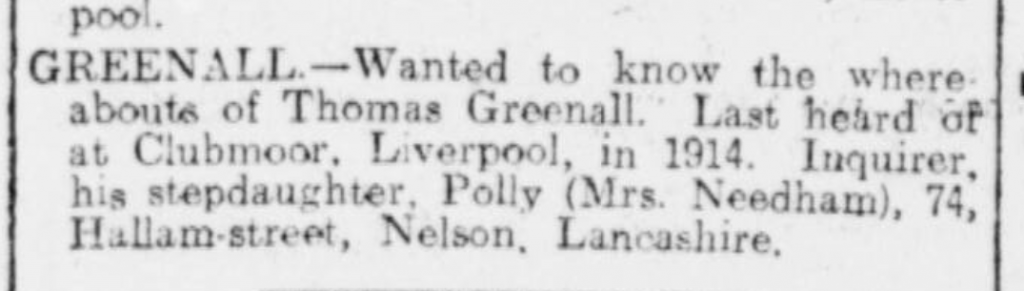
Regardless of James’s faults, he was clearly adored and respected by Elizabeth, and we wish we could say that she was also buried here but alas we cannot. She stayed a widow for nine years but remarried Thomas Greenall, a commercial traveller for an advertisement agency, in 1894. The marriage doesn’t seem to have been a happy one because Thomas left Elizabeth and went to Liverpool, and on the 1911 Census both of them resorted to the time-honoured tactic of pretending that each other didn’t exist: both labelling themselves as widowed.
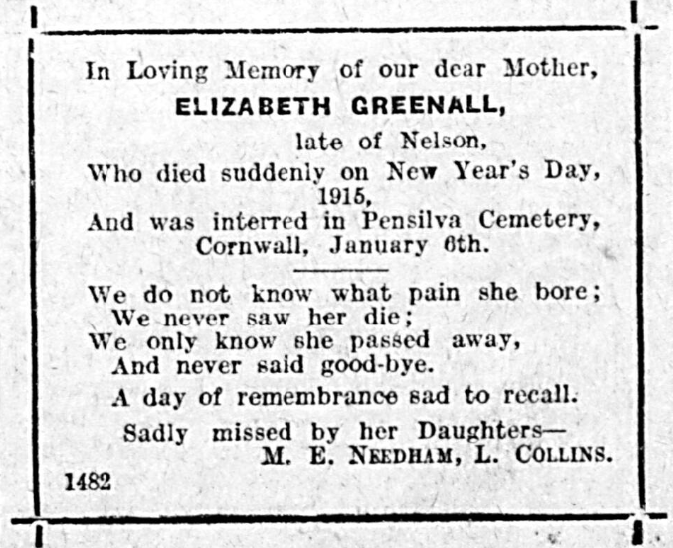
Elizabeth had returned to Pensilva near Liskeard, where she had been born, and in New Year’s Day 1915 she died there from a cerebral haemorrhage. Her daughters put a sad in memoriam in the newspaper the following year, and a few years after posted “where are you Thomas” advertisements in the Liverpool papers, to tell him that he was now single and possibly in line to inherit something (and maybe also to give him a bollocking). Whether he ever replied or not is unknown.
Maybe James Sims was a rascal, but he was a belovd rascal – we’ll give him credit for that.