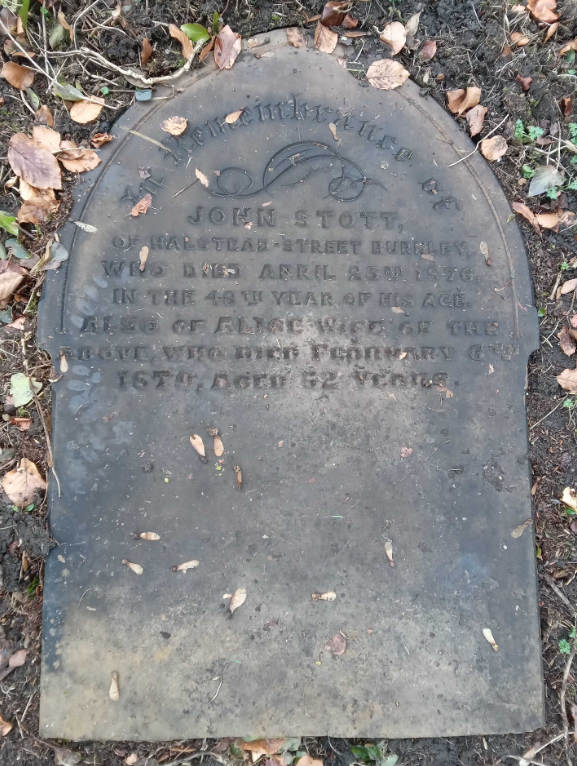
A Todmorden couple who crossed the border to Burnley, but held on to their Todmorden links to the end.
Alice Stott opens this story as the older member of the pair. She was born Alice Davies in 1827, the second youngest child of her father Peter and mother Hannah (Jackson). She grew up in the town centre, living at Bankside in 1841 and working as a power loom weaver like the majority of her siblings. The Davies family stuck together with the house at Bankside holding Alice, her parents, and her seven other siblings who were all over the age of 15!
We know a lot less about John’s history because of the time and the nature of his later work. We know he was born around 1829 in Warrington, to a George Stott who he would later say was a bookkeeper. We can only find one baptism around the time that would fit, and that George Stott is a flatman (aka a boatman), so we won’t waste time on what might be a red herring. John’s movements until he and Alice were married in Halifax in 1849 are difficult to trace but we can guess that he probably came to Todmorden in the early 1840s, because his career was as a railwayman.
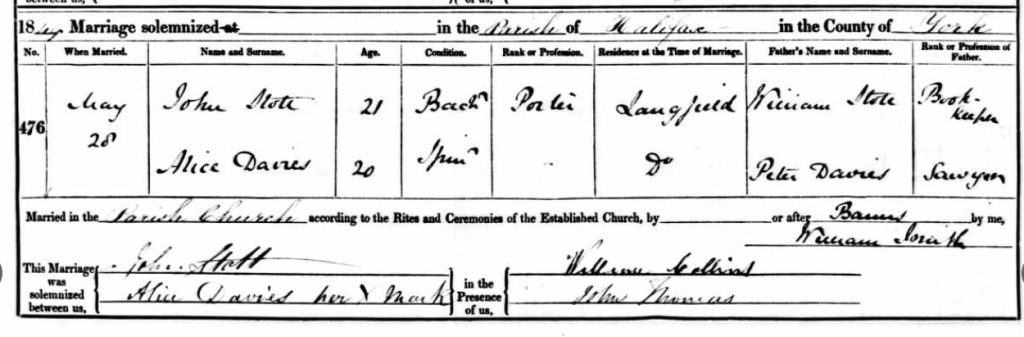
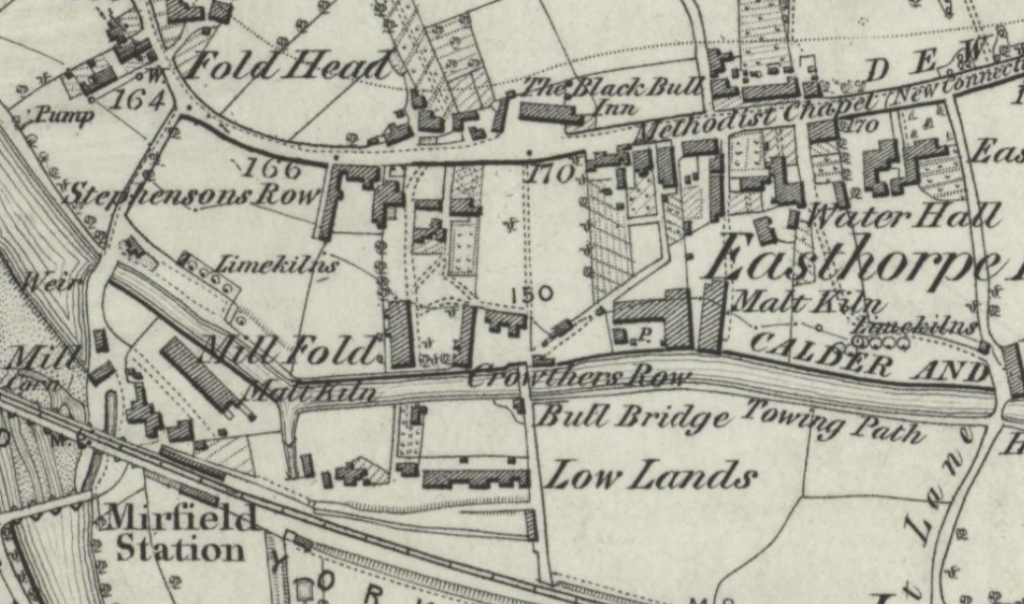
John worked as a porter and at first he and Alice stayed close to home – very close, as in right next door to her brother Peter and his young family at Bankside. Their first of five sons, William, was born there in late 1849. John was hard working though and willing to travel for work, and being posted to different stations was very common for employees of the LYR, so it’s no surprise that the Stotts would not stay in Todmorden forever. For some reason they were slow to baptise their children as they came but in 1856 all four of their sons at the time were baptised at St. Mary’s in Mirfield. John had been promoted to a guard and the move might have been part of it. The Stotts settled on Easthorpe Lane (the old name for Huddersfield Road) and would welcome their final son, Frederick, there in 1860.
By the 1861 Census, though, the Stotts had moved again, now to Burnley where they would remain. They found a house on Halstead Street, a stone’s throw from Manchester Road station, and settled in. John surprisingly avoided too much trouble in his job which involved travelling between Burnley and Todmorden on the train, with one notable exception being the time Thomas Greenwood of Shade got on drunk without a ticket and caused a ruckus.
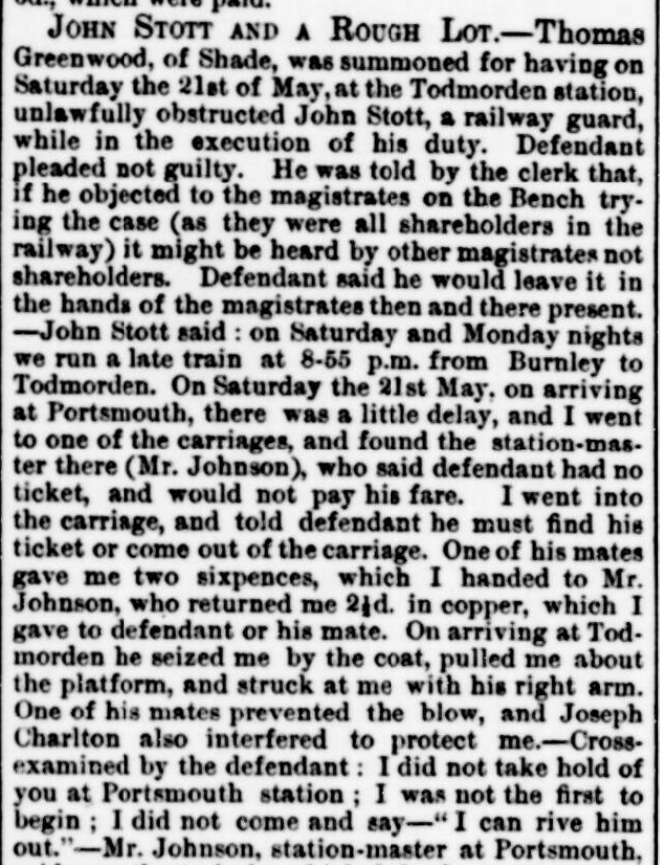
With the support of one of Greenwood’s embarrassed friends and Joseph Charlton at 49.58, John escaped with a mere roughing up rather than a broken nose or worse. The following year his occupation on the Census read “railway platelayer’s guard” so maybe this was just the last, biggest problem, and he’d had enough – what do you think?
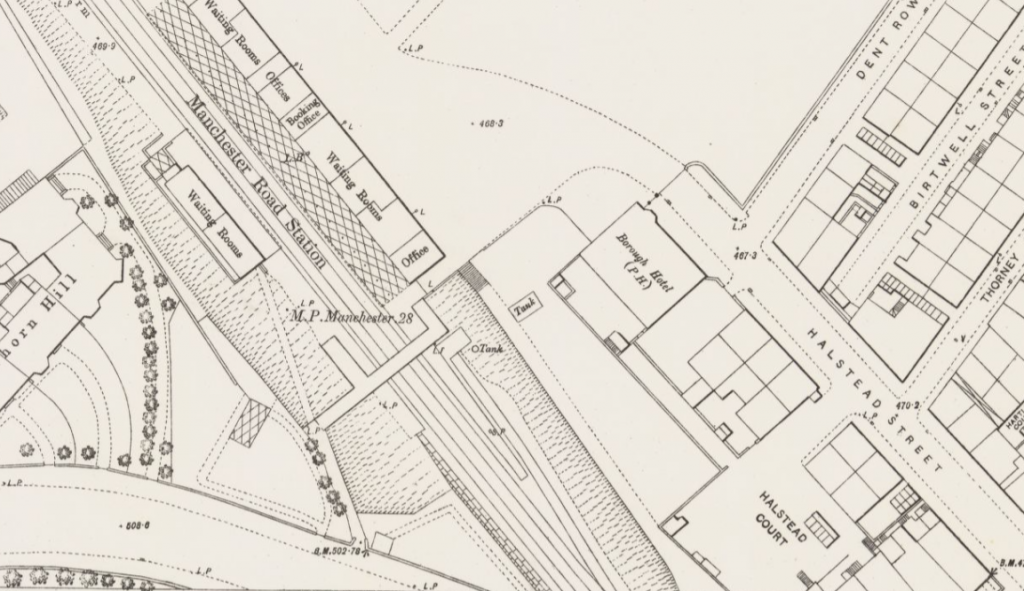
John and Alice moved to a house on South Parade – now the B6240, didn’t they make street names better back then? – but soon they would be back at Halstead Street, first on the terrace and then in one of the back-to-backs which were known as Halstead Court. Facing the railway line, that was there John died in 1876 from pleurisy as a complication of phthsis. Alice held on a few more years but her death followed in 1879 from the same causes.


It’s curious in some ways that the Stotts chose to be buried in Todmorden, at Christ Church, when the only familial link is Alice’s family and the only sentimental link the first few years of their marriage. John and Alice were lucky enough as far as we know to not lose any children and there are no infants or small children of theirs buried there. If they did lose children then they were stillborn, and not registered on the GRO. There could be some in the 6 year gap between their last two children’s births…but nothing can be proven. Maybe Todmorden was where they were happiest? Maybe Alice wanted to be near her family and John’s death first meant she could exercise her preference? A few theories, but nothing more than theories.