Next time you wander up Stansfield Hall Road and stop to smell the flowers, ask yourself who might have been smelling them 120 years ago…and who might have been planting them then too.
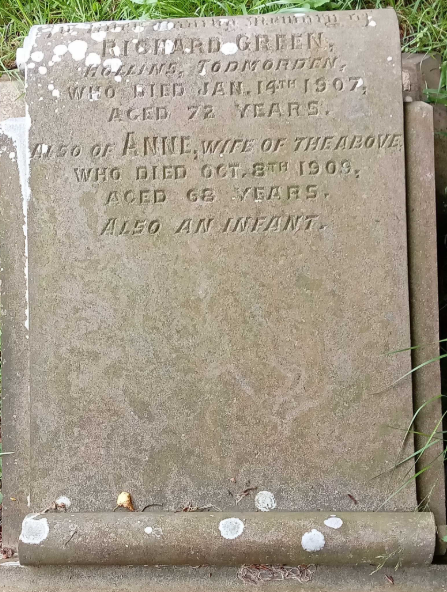
This grave’s story starts in Child’s Ercall, Shropshire, in 1836 with the birth of Richard Green. Richard grew up in a household made up of his grandfather Samuel, his parents Thomas and Ann, and many siblings. Thomas was a shoemaker but Samuel was an agricultural labourer and Richard took after him in one respect: working outdoors. As early as 1851 he was working as a gardener and took his work seriously as we will see later. Someone in his household or local school made sure that he learned to read and write which would also help him to become more than “just” an agricultural labourer.
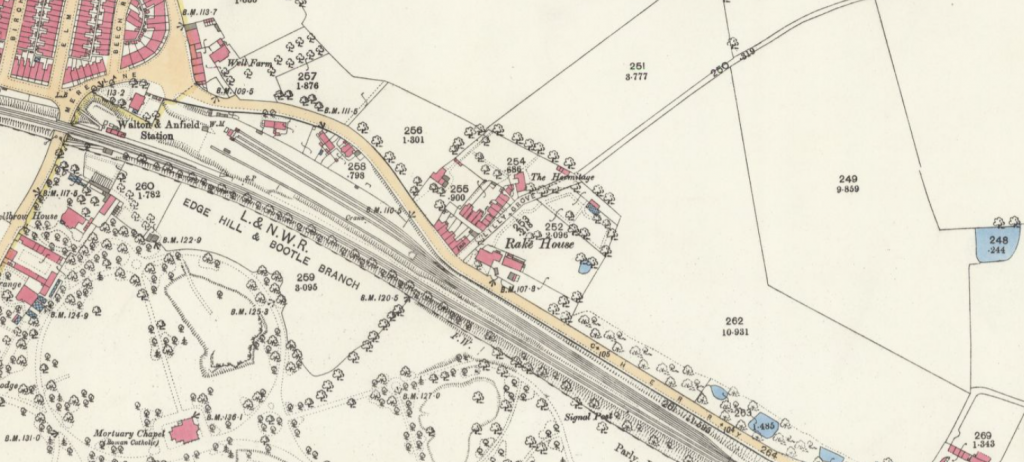
By 1861 he had left Shropshire and gone to Walton in Liverpool to work as a “gardener servant”, and it was there he met Anne Baker. Anne was the daughter of a gardener servant herself, and it seems plausible that the two met through her father James. They were married at Christ Church Everton on April 1st 1861 and when the Census was taken six days later they were living apart – Richard gardening next to Lilly Grove and Anne laundering at Cherry Lane with some relatives. Both places are now, of course, part of Liverpool city’s urban sprawl, but then this part of Liverpool was sandwiched between the railway and Liverpool Cemetery to the south and the open farmland below Walton Hall to the north.
It’s likely that Richard worked for the Leyland and Naylor families at Walton Hall because he and Anne would pack up their three children in 1866 and bring them east to Todmorden, where Richard found himself employed as Samuel Fielden’s chief gardener at Platts House. Only the Fieldens here, at that point, would have had comparable wealth to the Leylands. “Black Sam” might have had local power but his servants didn’t always benefit from the same deference, and on Richard’s debut showing off his produce at the Flower Show in 1866 he won a few prizes but comments were passed in the newspaper to the effect that “there might as well have not been any judges present”, and Richard felt something was behind this remark sufficiently for him to write a snarky letter to the paper assuring everyone that he had, in fact, produced some very nice fruit and flowers indeed, and his position was nothing to do with the prize giving.
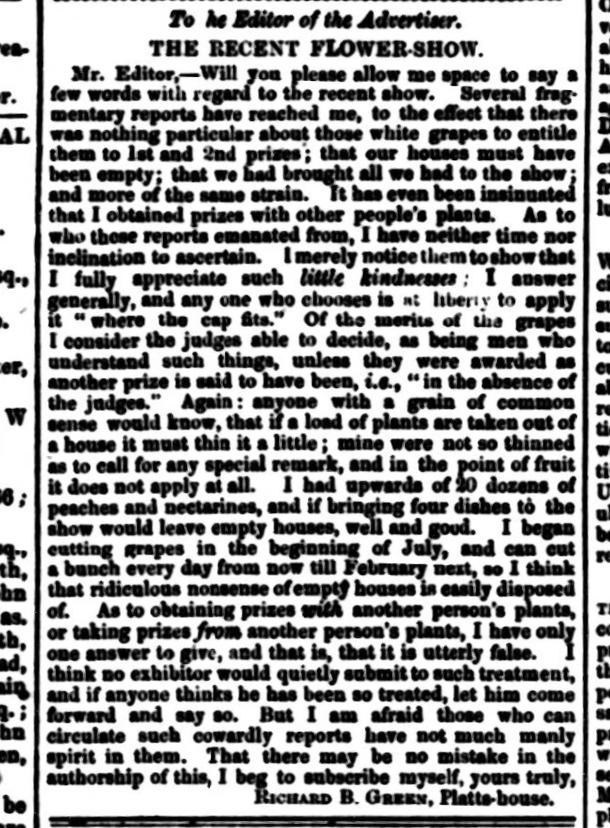
Such “little kindnesses” indeed!
Richard and Anne continued to grow their family but in 1869 lost their sixth child and third son, Charles Harry, two months after he was born. They kept going though and soon whatever sore feelings 1866 brought were forgotten. Richard eventually became the Secretary for the Floral and Horticultural Society, Chairman for the Widows and Orphans Fund, and earned a bit more local respect as a result. He also continued to work for the Fieldens until the late 1870s when he took up working for Edward Lord at Adamroyd instead, and the Greens moved from Centre Vale to Barker Street to be nearer his new workplace. Because he was also clearly not occupied enough, he joined the choir at St. Mary’s and started helping out with the Shannon Botanical Society, serving the amateur gardeners of Millwood.
Time passed and Richard continued to get involved with groups, now becoming a volunteer with the Lancashire Fusiliers, and in the 1890s retired from gardening for others to take on gardening for himself – on his own account, as it were. He bought out Barker and Greenwood, who ran the nursery off of Stansfield Hall Road, and began operating it himself, selling flowers and vegetables. He must have been earning some good money or investing it well because he and Anne also moved up to Hollins Cottage and much nicer digs. With her own children growing up Anne found herself taking on work with the Lords and on the day of the 1891 Census was actually listed as living at Calder House with Will and Florence Lord and their two small children, and working as a nurse. It’s unusual for two happily married people to be found living apart twice on a census return!
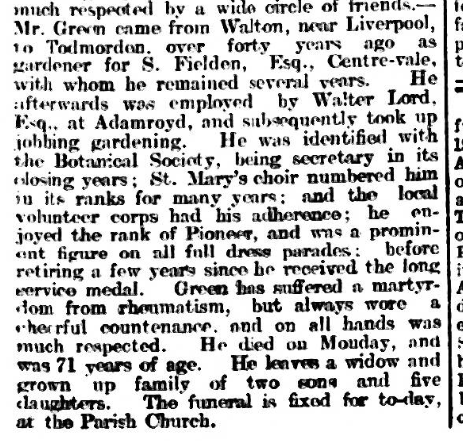
In their old age the couple began to wind down, and Richard went from gardening and armies to chairing the Old Folk’s Tea Party committee. He also began to suffer from rheumatism. In 1907 he died and was given more than a few lines in the newspaper, his egregious prize-winning sins of 1866 long forgotten.
What did Anne do next, Anne who worked hard and no doubt was there helping support her husband as he became more and more unable to fend for himself due to arthritis? Well, she left Hollins Cottage and ended up down at 19 Victoria Road. Looking at later census returns we can see that her eldest son James lived at 15 with his wife and family, and her daughter Bessie, Bessie’s husband Wilfred Pickles, and her other children Emily, Sam and Harriet all lived at 17. Earlier though? It might be that there were Greens in all three houses along that row. Anne died in late 1909, and Bessie died in early 1911. Perhaps after one of those deaths two of the households combined themselves together – otherwise the setup in number 17, of a man, his son, his three siblings-in-law and a nephew-in-law, is rather a strange one.
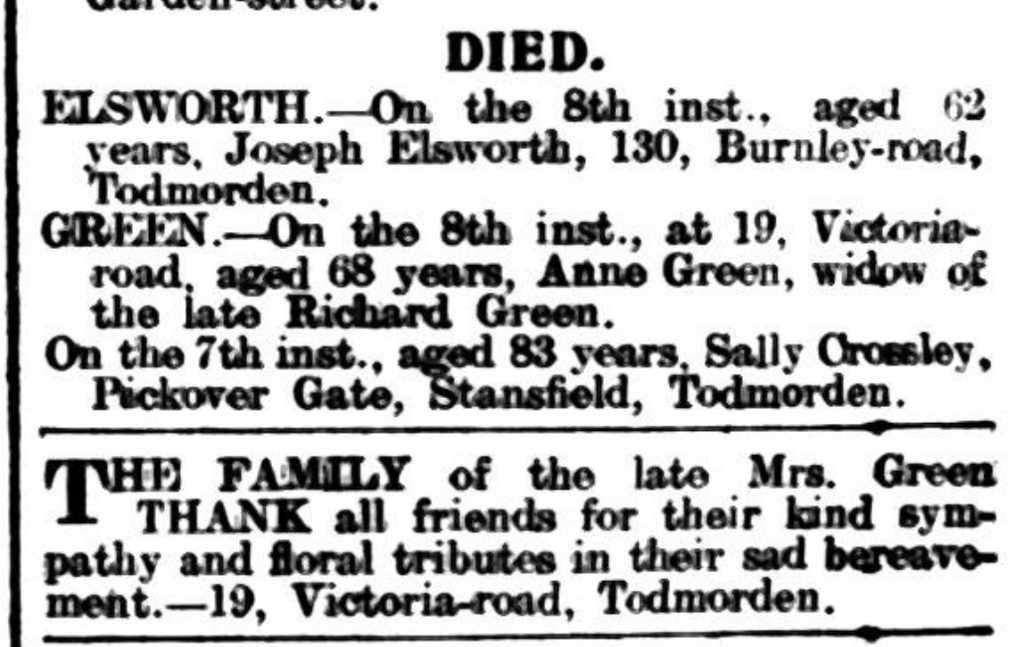
Anne, of course, was memorable as Richard’s widow, but between her children’s strong sibling bonds and her work helping to look after other families, there were no doubt many others who remembered her fondly too, and as a person all her own.