Maybe “completely unobtainable” is better than “inaccessible” – John Wright’s location is likely here, although we can’t be sure due to a number of factors. While trying to see if he might be somewhere else we uncovered a short but fascinating story that it seemed unfair to leave off the website purely because of that lack of clarity.
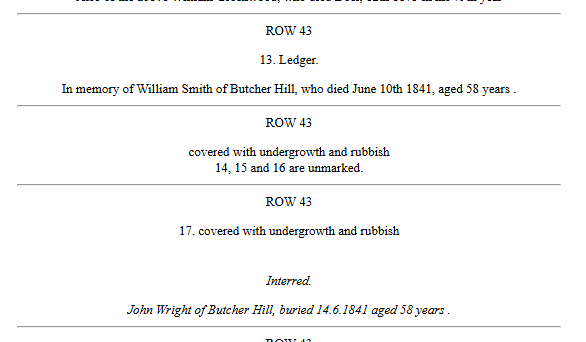
Our problem mainly lies with the 1986 ACT transcript, which gives the information for this grave as “John Wright of Butcher Hill, buried 14.6.1841 aged 58 years.” First off, this is an error based off of the grave that comes before this, that of William Smith of Butcher Hill who was buried on that date and of that age. Someone copied and pasted by accident. When we checked the burial registers for John Wrights we found one who was actually born in 1841, so maybe the error came from the gravestone having John’s date of birth and death on it? It’s plausible. This is that John’s story.
John Wright was born at Burgy (aka Springside) to Stephen and Amelia aka Milley (Helliwell) Wright, the first of their five children. Stephen was described as a labourer in 1841 but in 1851 was a delver, and in 1861 was a schoolmaster living at Bridge End at Shade. Quite the career progression! John took the middle pathway and found work learning how to make pickers for cotton looms. Good money, some education needed, but still hard work (just not as hard as delving).
In 1863 John moved to Pexwood and married Elizabeth Smith, a cotton winder ten years his senior. Elizabeth had lost her father James while still young and was raised by her mother Martha and stepfather, also James, Ogden. These names are all important because John and Elizabeth started their family the following year with their son James Henry – James for Elizabeth’s two fathers and Henry for her youngest brother John Henry Ogden’s middle name. Two years later Elizabeth became pregnant again, and the couple must have been very confused, because she would have grown…and grown…and conception and due dates hotly discussed and disputed and puzzled over as she got bigger and bigger. Back then it would have been difficult to predict what was about to happen:
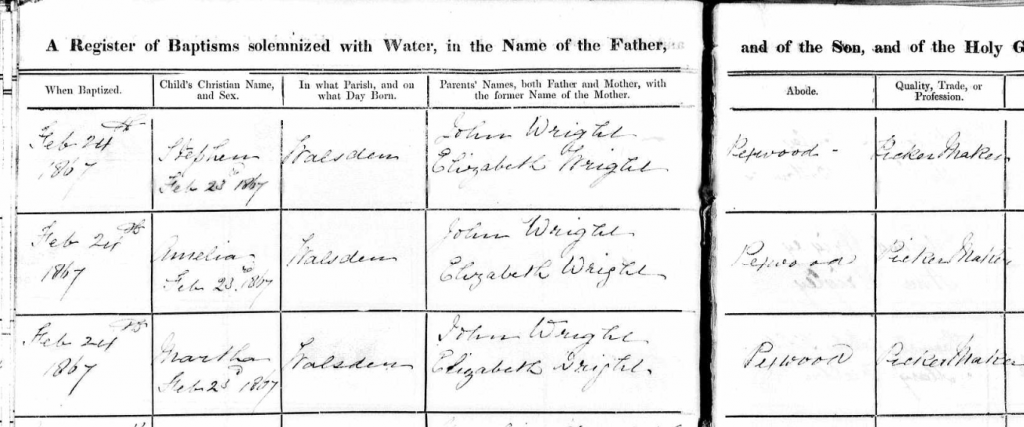
triplets.
After what was probably a terrifying delivery, the Wright household doubled. Now there was James Henry and Stephen, Amelia, and Martha – more names we’ve seen before. John and Elizabeth both had three more mouths to feed and both must have wondered about the respective logistics of this. Whether it was health issues during gestation or delivery, or poor luck, this situation didn’t last long. Two weeks later the last baby out, little Amelia, died. John and Elizabeth had only recently received a three guinea gift from Queen Victoria herself, and what must it have felt like to have to use some of that money to bury their little baby…
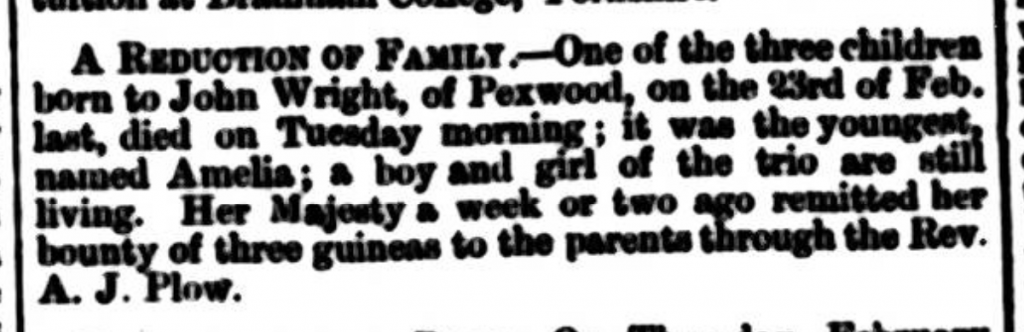
A few months later baby Stephen also died, and now the family of six had gone back down to four. The gift of money from the Queen is why we think John Wright does indeed have a gravestone, somewhere on the back slope, and that he isn’t the only one in it; there was no financial reason for the Wrights to not have bought an exclusive grave plot. But we’re getting ahead of ourselves a little. And it isn’t set in stone (no pun intended) because Elizabeth had a half-brother buried in the private area of Christ Church and the babies could be up there.
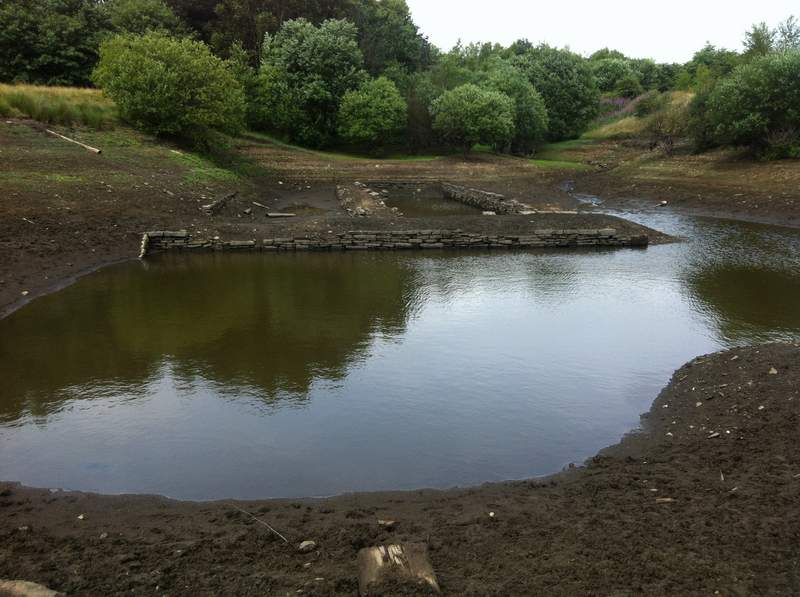
The Wrights lived next door to James and Martha Ogden and this family support helped them weather their losses, and this was still the case in 1871. They would all soon up sticks to move further into Lancashire though. BY 1876 they had taken up residence at Roads Mill, Watergrove, which we can’t show you on Google Maps now without some difficulty. It’s now underneath the reservoir and remains of the buildings are only visible when the water is very low.
John was working as an engine tenter at Roads Mill but by 1891 they had moved along to Clough House Farm where John was a tenant farmer. Both children had moved out but the now-widowed Martha Ogden was still living with them as well as a farm servant. James died the following year from pleurisy and pneumonia, and he was buried here most likely (as we said) with two of his triplets.
Elizabeth and her mother went to go live with James Henry and his wife and children in Milnrow, but both didn’t have much longer to live. Martha Ogden died in 1900 at the age of 90 and Elizabeth in 1904 at the age of 73. Elizabeth is not named on her mother and stepfather’s stone so is she here with John? Perhaps. But until the “undergrowth and rubbish” are cleared, which is unlikely to happen soon given this grave’s location on now-private land as well as there being a big tree growing partly over where it once stood, we won’t ever know.
At least now he isn’t entirely forgotten.
