And not just them, but also George, Samuel and Mary’s third child; he may well be buried here, but like so many other “last one in”s, never had his name make it to the stone itself. The reason why is somewhat melancholy.
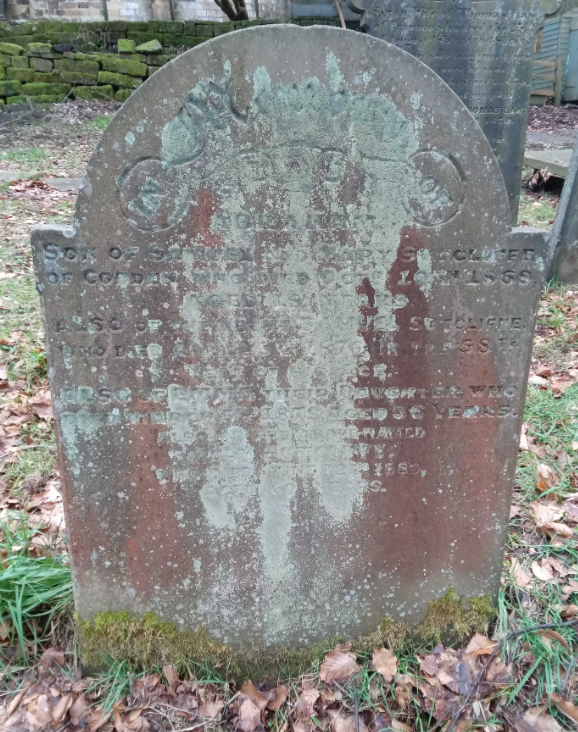
The Sutcliffes had fairly normal lives, apart from George. Samuel was born in 1818 and his future wife, Mary Law, in 1823. Samuel’s father Daniel was a stonemason but Samuel became a weaver instead. Mary’s father John was a general labourer. Working class people doing what most working class people did – working. Mary no longer worked after the couple married in 1842 but all three children – Emma, then George, then Abraham – started working in cotton weaving sheds as soon as they were able.

The Sutcliffes lived up at Oldroyd, above Kilnhurst, for the first 20 years of their marriage. They would later move down into the centre of Todmorden and settle at Peel Street in Cobden. This was not a step up; quite the opposite. The houses where Aldi and Todmorden Learning Centre now stand were slums, with significant problems involving the houses being lower than the road and not much higher than the watershed. Their privies were in their basements and so the results of any heavy rainfall or flooding are easy (if unpleasant) to imagine. During the Cotton Famine a lot of people found themselves in difficulty and perhaps the Sutcliffes were especially hard hit. Between the aftereffects of poverty and the ever present effects of their living situation, it’s no surprise that their health suffered. Abraham died in October 1868, only 18 years old, and in 1876 Samuel followed him. In 1879 Emma died. Eleven years and three down; only Mary and George were left.
None of the three Sutcliffe children ever married, but George came closer than the other two. He fell in with Mary Ann Mitchell of Shoebroad and in 1871 she had a little boy out of wedlock. He was named Abraham. The two seem to have fallen out by 1873 when Mary Ann finally had her son baptised, with George’s name written in but then scribbled over. Had George gone back on claiming his son as his?

Things went back and forth for a while. He stopped contributing in late 1876 and Mary Ann took him to court in April 1877 over the matter. The child was now six years old – was it so important? The answer was yes, for a reason not accounted for in the court coverage. Mary Ann was unwell. She died in November 1877 and young Abraham went to go live with his uncle Thomas and aunt Grace in Eastwood, where he would live for the rest of his life (he died in 1927). For whatever reason his Sutcliffe relatives either didn’t want to or couldn’t take him in.
George and Mary stayed together, moving up to Fair View where hopefully the air and cellars were a little cleaner and clearer, and in 1889 Mary died and became the last name engraved on this stone. Whither George though? Well, George moved to Longfield Road and later to Eagle Street, lodging with couples in need of a little extra income. He continued to work as a weaver but was let go from his post at Derdale due to an economic slump. He found temporary work with the Todmorden Carriage Company but when that contract ended he was unable to find work back at Derdale. He seemed to be taking things in his stride, but one evening shortly after Christmas 1894, he wandered down to the Lord Nelson at Salford for a few pints, and on his way back accidentally found himself in the canal lock next to the library. Poor George wasn’t found for several weeks, and his cause of death ultimately ruled inconclusive.
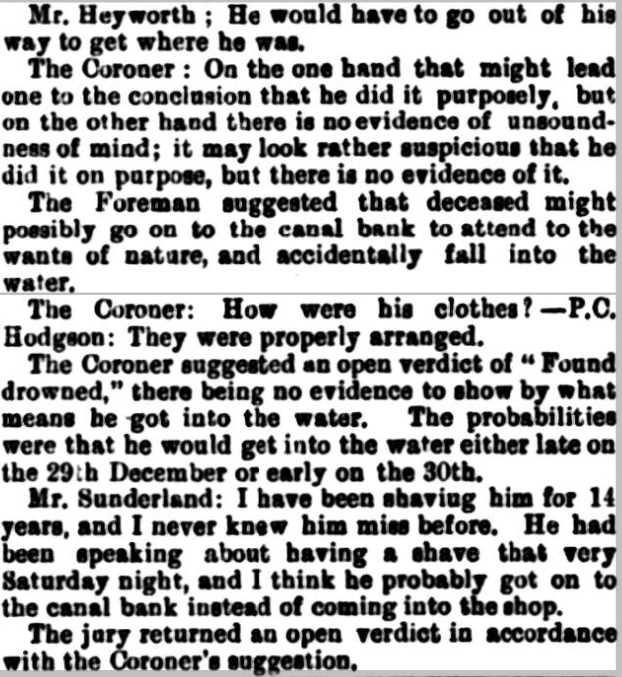
The jury heard that George had no close family, only “some cousins living in the neighbourhood … but they never owned one another; one lived at Eastwood.” How sad, but it explains why George’s name isn’t on this stone despite him being buried at Christ Church, and almost certainly buried here. If they wouldn’t “own him” in life, why would they acknowledge him in death?