It’s curious that this mother and son have a gravestone, because their lives were marked by poverty. Some of this was circumstantial, and some…inherited…
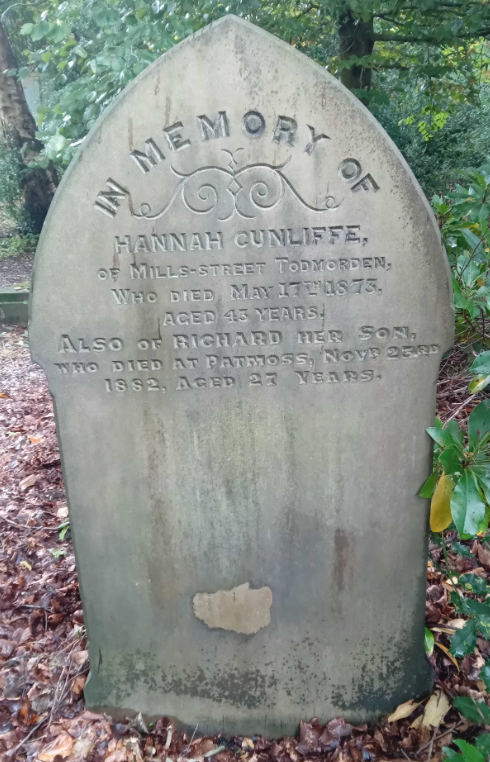
Hannah Cunliffe was born in 1830, the illegitimate daughter of Ann Cunliffe of Burnley and later Heptonstall; and the story here really starts with Ann. Ann was one of many Cunliffes of Burnley area origin who had settled in and around Todmorden, and in 1854 had just moved from High Street in Shade to Hanging Ditch (the bottom of Longfield Road) with her daughter Hannah and granddaughter Betsy. It was there that someone told her about a man who lived in Oldham who was an expert in probate law and who spent all his time and expertise helping impoverished people gain access to money that they were due. Hannah saved her pennies and went to visit him.
John River Burdett Howcroft – what a name! – was in fact a retired coal miner, but one who was educated and who had spun a scheme to line his own pockets in retirement by getting poor folks who couldn’t read or navigate the law themselves to pay him to do it for them. Was he legitimately able to get money for people? Sometimes, maybe. But when Hannah went to him asking about a persistent rumour within the family that Wycoller Hall belonged to the Todmorden Cunliffes he saw pound signs in his eyes, and that began a three year period where Hannah and her siblings and cousins all scraped money together to pay Howcroft the money he needed to attend court in London and advocate on their behalf. It ended in 1857 when Hannah managed to charge him with fraud, and he was arrested in Oldham and brought before Abraham Ormerod at the magistrate’s court in Todmorden.
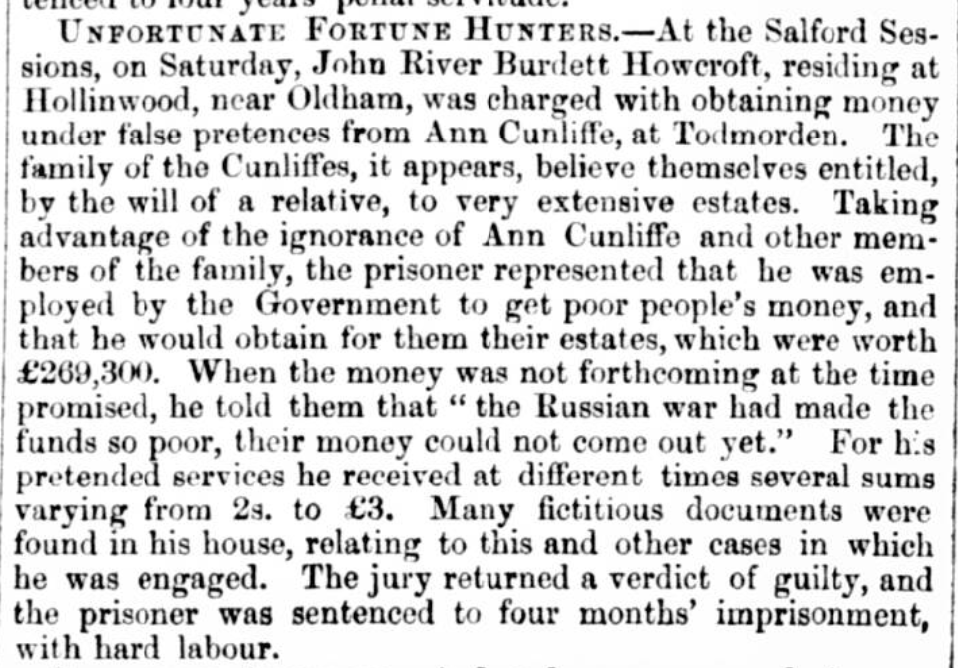
It took another year for the case to get before the Salford Quarter Sessions, when Howcroft was found guilty and sentenced to four months in jail with hard labour. This never came to pass because less than a week after the verdict was handed down Howcroft was dead, apparently riddled with heart disease and multiple organs fused together. It was suggested by the coroner that if his heart hadn’t been so diseased he would never have gotten up to the level of mischief he was engaged in…what do you think, does that sound very scientific?!
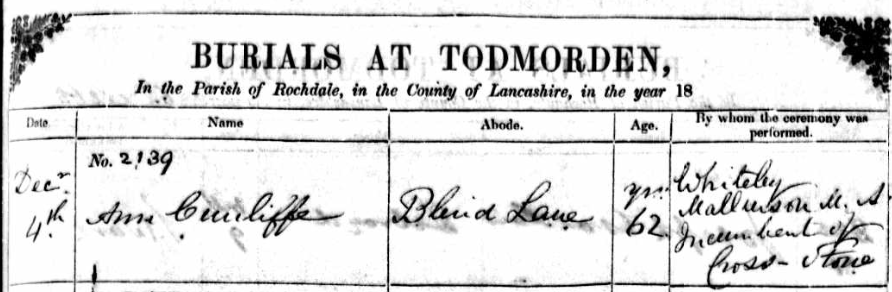
Anyway, Ann and her extended family had shelled out a great deal of money, and it left Ann and Hannah struggling in particular. By 1855 Hannah had given birth to her second child, Richard, and on the 1861 Census Ann, Hannah (mistakenly also named as Ann), and Hannah’s children Betsy and Richard were all living at Blind Lane. Betsy was only ten years old but working as a throstle doffer, because every penny counted. Blind Lane wasn’t the nicest place to live, between regular flooding and the traffic back and forth from Dick Holt’s inn and lodging houses, and their time there speaks very clearly to the financial situation they were in. Ann’s health in 1861 prevented her from working and unsurprisingly she died in 1862.
Now what about Hannah? Hannah was born in 1830 and so would have undoubtedly also been putting her few pennies towards Howcroft’s scheme to enrich the family. She herself was a cotton winder and had two illegitimate children of her own, Betsy (born in 1850) and Richard (born in 1855). After Ann’s death Hannah and her children moved to Mills Street in Cobden, where the College is now, which was no better than Blind Lane would have been for flooding and difficult neighbours. Betsy got married in 1869 to a stonemason named Samuel Greenwood and all four of them lived there together.
Unfortunately Samuel’s presence didn’t help stabilise the Cunliffe household. Sam was a bit of a one. When Hannah died in 1873 the family was able to cobble together enough for an exclusive grave (more than grandmother Ann had managed to get) and a stone, perhaps sourced by Samuel…but Samuel disappeared shortly afterwards, abandoning Betsy and their two children. Betsy ended up living separately from Richard because he found himself a wife but this wife is perhaps not really a wife. By 1881 Richard was living with his “wife” Mary on Back Patmos but we can’t find a single marriage on the books anywhere that would appear to be between the two of them. In fact only one marriage between a Richard Cunliffe and a woman named Mary took place at all in the entire country between 1871 and 1881 and that was in December 1873 in Haslingden. That Mary, Mary Holt, was born in Rossendale, but Mary Cunliffe on the 1881 Census said she was born in Huddersfield. Mistake? Who knows.

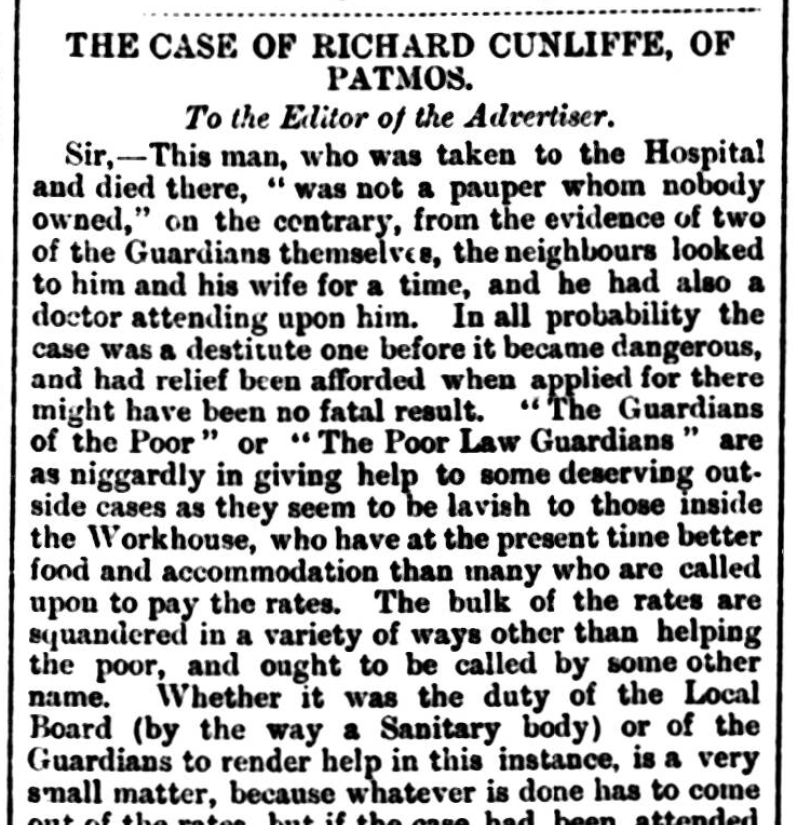
What we do know is that Richard and Mary had no children and were extremely poor. Richard’s occupation in 1881 was “hawker” which was really only probably one step above rag and bone man, if even that. While Betsy struggled with her back-and-forth husband and her own issues, Richard and Mary struggled with theirs. Their home at Patmos was above a slaughterhouse – can you imagine the smell in the summer, and the noises all the time? – and it’s no surprise to then learn that in November 1882 he became sick with suspected typhoid fever. Dr. Thorp was called, and he recommended to Mary that Richard be sent to a hospital at once. Only one problem: they couldn’t afford it. Worse, the Cunliffes had not wanted to go on parish relief, and had next to nothing to their name. Why was this? Betsy had applied for relief after all and gotten it. This is why we wonder about their marriage; maybe not all was quite right with it and they didn’t want it exposed. Unfortunately this decision was used for some spectacular buck-passing by local authorities, and Richard became more famous in death than he ever was in life.
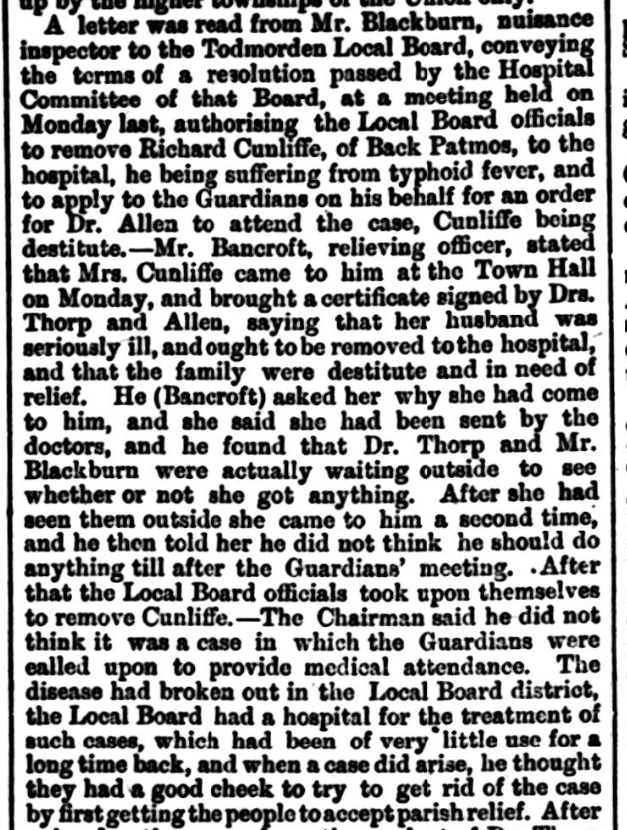
In short, the Local Board sent Richard to the hospital but charged the Board of Guardians with paying for a doctor to attend, while the Guardians said absolutely not, the family aren’t receiving relief, his costs are on the Local Board. Mary was encouraged by the Local Board’s doctors to claim parish relief which the Guardians objected to as buck-passing. It came out later that the Cunliffes had been struggling for a while and that their neighbours had been taking pity on them, and that Richard had been unwell for a time before contracting typhoid, and that their situation was truly desperate.
Richard lingered in the hospital for a short while but died there on November 23rd. Meanwhile the arguments over who would pay for his medical care rumbled on. Maybe this is why they had resisted claiming relief for so long – who wants their lives (and death) to be litigated and examined again and again in the local papers? It would not be until October 1883 that the account for Richard’s care was settled by the Local Board, all £2 5s of it.
The question of whether this long chain of events would have happened had Ann Cunliffe not gone to Oldham to visit John River Burdett Howcroft back in 1854 is one we can’t answer.
As for those left behind: Betsy Greenwood had two more children by her feckless husband (including one named Richard in 1883) and spent another 10-15 years making excuses for his increasingly drunken behaviour before he left her a free widow. And Mary? Mary disappeared as mysteriously as she had arrived.