This Firth family has a few graves at Christ Church, but as we’ve gotten to this one first, we’ll start with this one.
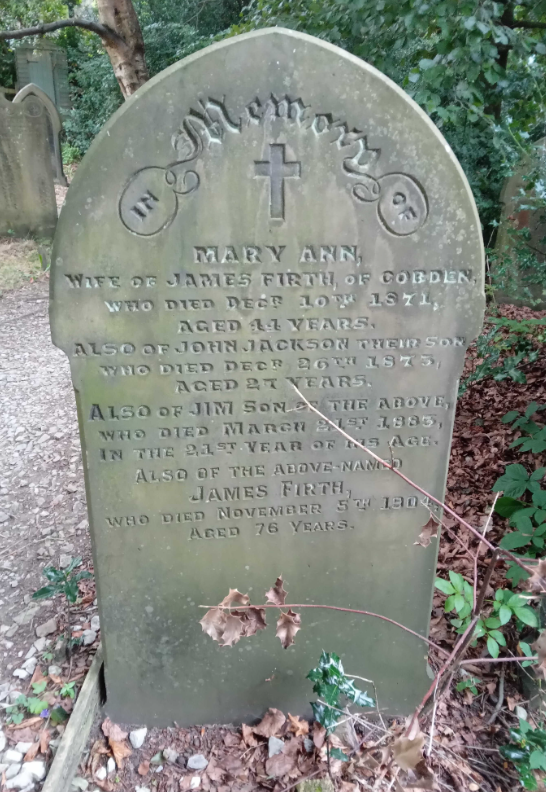
Samuel Firth of Marsden and Betty Longbottom of Luddendenfoot are the ones who really started it, with their marriage in 1826 at the respective ages of 19 and 18. They were in love and Betty was well into her first pregnancy: their daughter Martha, who was baptised at St. Mary’s in October 1826 and who was the only Firth child to be baptised there. James, David and John followed, then a fourteen year long pregnant pause (see what we did there?), then Elizabeth, and finally Major in 1850, when Betty was 42 years old. John and Major are buried elsewhere, and James is here.
James became a wood sawyer and made his home at Bankfoot, later Goshen Terrace, near to John Holt’s timber yard where he may well have worked. Further down Rochdale Road, in Gauxholme, lived a young woman named Mary Ann Jackson, whose origins are difficult to discover. Her father’s name was William, she was born in Todmorden and lived in Walsden eventually, but an 1841 Census entry for her is difficult to pin down. We think that 13 year old Mary Ann Jackson, a cotton spinner, is her…but if so, her life was clearly already a troubled one. This Mary Ann was lodging with widower John Lapish, his two young sons, and his dead wife’s father William. Imagine being 13 and having to work, with your wages only going so far as to ensure you could pay your rent.
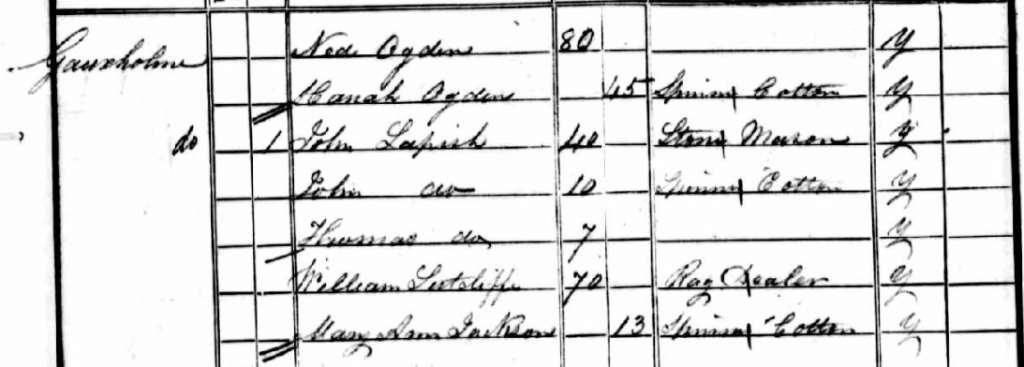
It’s also possible that she was the Mary Ann Jackson born in 1827 to Phoebe Jackson and Lawrence Raby, out of wedlock. Phoebe and Lawrence never married and Phoebe herself died in 1833, which would have left Mary Ann a truly friendless child. John Lapish is to be commended for giving her a roof over her head.
Unfortunately James and Mary Ann were a bit hasty, and in 1846 their first child, John Jackson, was born. James was 20 and Mary Ann either 17 or 18, and even without parents the adults in her life were a little unsure about a marriage being right at this stage. She was still a minor and so James kept working. By 1849 any remaining hurdles had been cleared and the pair were married at St Chad’s in Rochdale in April of that year. Six more children came along over the next 16 years: Alice, Phoebe (you see why we wonder?), Eva, Major Edward, Jim (who was christened James), and Jacob Edgar. Alice, Major and Edward are also buried at Christ Church, but again, their stories are for another day.
By 1871 the Firths had moved to 10 Ridge Street (sometimes also known then as Garden Street, as you will see), and on the Census that year, everyone is working apart from Mary Ann and five year old Jacob. Jim, the next oldest, is a scutcher at age 10. It was a different time! Mary Ann was not only tending the home, however. She was also tending her health, and failing to manage. She would see out her last days at home as a victim of Victorian England’s favourite illness, consumption. Jim was at her side when she died there at the age of 44.

Two years later, John Jackson died, in his case from bronchitis. In death, James made sure that the question of his son’s legitimacy was concealed, and his death was registered as John Jackson Firth rather than his legal name of John Jackson.

Present at John’s death was a Mally (Howorth) Webster of Queen Street, one of the streets that once stood at Cobden where Aldi and the college now stand. Queen Street wasn’t far from Ridge Street so she probably already knew the Firths. She herself was a widow, her own husband James having died earlier that year. She and James Firth found some comfort in each other and two years later, in 1875, they would marry. She had five children of her own, the youngest aged 15 at the time of this marriage, so even assuming only the youngest few were still at home…that was one crowded home.
By 1881 most of the children had moved out and it was just Major, Jim and Jacob at home with James and Mally. More loss was soon to come, this time not due to a lung complaint but a heart complaint. Jim, christened James but known to all as Jim, had mitral valve disease (which was a surprisingly common side effect of various childhood diseases such as measles). He did catch bronchitis, but was listed as a secondary cause of death. The heart problem had already been identified, and he and his parents had probably already been keenly aware that Jim lived on borrowed time.

But that wouldn’t have softened the blow when the blow came. Just as with his older brother, Jim kept his “family” name in death and was registered as Jim instead of James. His sister Alice (now a Halstead) nursed him at the end.
James and Mally stayed at Ridge Street but eventually moved to a smaller house on Back Ridge Street – just three occupied rooms, but that’s all the pair needed. James continued to work as a sawyer. Mally died in November 1902 (she was six years older than James so was about 80 years old) and was buried with her first husband. James died two years later in November 1904 and was buried here.
…that’s not the end of his story though. James lived a quiet and peaceful life and garnered more lines in the newspaper in death than he did in life due to a life insurance policy his daughter Phoebe had taken out on him in 1886. A less trusting older person might have viewed such an act with some trepidation but obviously he lived for many many more years, so it wasn’t step one in a nefarious plot! More like a desperate one. Poor Mary Ann would have been sad to see her possible mother’s namesake fighting an apparently losing battle with alcoholism, and it seems as though the policy was intended partly as a financial boon that might have allowed her to leave her unhappy marriage, or as an insurance policy to ensure she could still access drink even without her husband Frank Eastwood’s permission. The facts of the case were that after James’s death, Frank got their son to retrieve the insurance policy from Phoebe while she was living in Rochdale, and the two fought over the payout. Frank maintained that he had paid for two years so was entitled to a portion of the payout but was also concerned that Phoebe’s siblings would not see any of the money, and also mentioned that she had gotten some money from Mally’s estate and was also the administrator of James’s estate too. The implication was that she had drank it away. In the end, possibly with Phoebe’s other appearance before court from the year before where she had embarrassed herself severely, the judge awarded just under half the payout to Frank with the understanding that he would ensure the other Firth siblings had some share of the money.
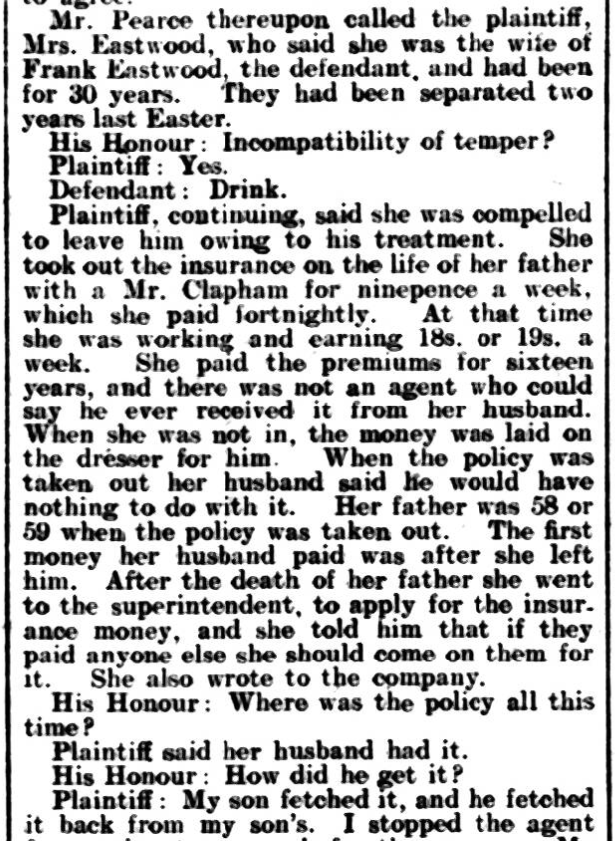
Not how James would like to have been remembered.
As for Phoebe and Frank, on the 1911 Census they were living separately, but by 1921 they had reunited due to Frank’s ill health forcing his retirement from work. She died in 1927 and is buried somewhere at Christ Church, but we don’t know where – possibly with her and Frank’s only son, John Edward, who died in 1905 and is buried with his wife at 15.12.