A farmer’s grandson who made the ultimate sacrifice is remembered here. The question is…why?
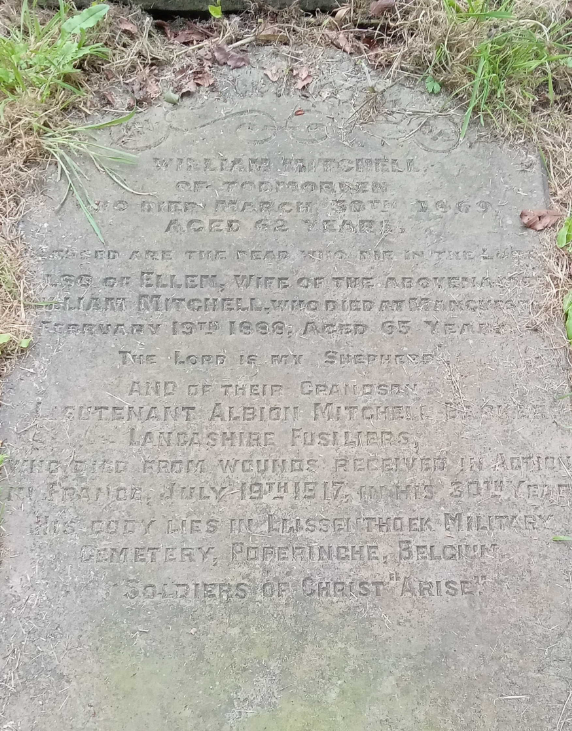
Maybe we can figure out the “why” from the first story here. William comes first. Born in 1807 in Todmorden, William was the son of a farmer and became a farmer himself. William Sr. lived at Scaitcliffe but William Jr., our William, moved around a bit more. In 1847 he was still living here, and that year he got married for the first time. His first wife was Ann Fielden, and the two settled at North Scaitcliffe where he was farming 19 acres of land according to the 1851 Census. They later moved to Whitfield, near Littleborough (Whitfield Brow still bears the name), where Ann would die in March 1857. Ann is actually one of the last people to be buried at St. Mary’s before their graveyard closed for good in October 1857…one reason why her name doesn’t appear here.
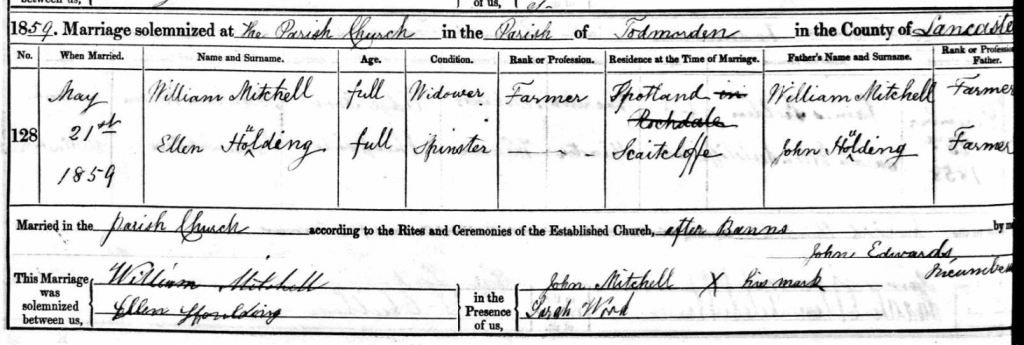
William waited two years and then remarried, this time to Ellen Houlding of Scaitcliffe. He hadn’t moved back – he was still over the border – but must have met her while visiting family. Ellen was not a Tod lass, but was in fact from Chorley originally. She was also educated enough to write her name, and confident enough to ensure that the curate who initially spelled her name wrong made the correction on their marriage certificate! Unfortunately we’ve struggled to find much other information about her. Her father John was also a farmer so perhaps she and William bonded over this. What else they bonded over is unknown. There was a 16 year age gap between them but Ellen was, by 1859, 36 years old, and perhaps she felt time was marching on for her. William and Ann had not had any children of their own that we know of, and perhaps he was also conscious of time…
Ellen had her first and only child, a daughter named Mary Ellen, just over a year later in 1860. William was now farming at Featherside Field in Spotland, only 11 acres now, The family would soon come back to Todmorden, and it would be there that William died in 1869. The Mitchells had moved to a house on School Lane, in the town centre, and on the 1871 Census it was just Ellen, Mary Ellen, and a lodger living there. William had left behind an estate valued a little under £450 but his widow didn’t wish to spend it all at once and managed her money very carefully. Don’t let the presence a lodger in 1871 fool you…the lodger’s rent meant Ellen could stay home and Mary Ellen could stay a scholar, both for as long as possible. The gambit paid off: Mary Ellen became a schoolteacher.

Ellen’s unmarried sister Adelaide joined them after a time, and eventually they left Todmorden behind. Mary Ellen left it for a teaching job in Witherslack near Grange-over-Sands, and Ellen left it for Manchester. Todmorden wasn’t done with Mary Ellen though – specifically, up-and-coming solicitor’s clerk Jackson Barker of Well Street wasn’t done with her. The couple were married in 1886 and Jackson whisked her off to his new job in Manchester to start a family. Ellen was able to live just long enough to see her first grandchild, little Albion, born the following year. She died in 1888 and joined William here in their grave at Christ Church…
…and that’s the end of their story. But what about Albion, and again, why is he remembered here?
Albion Mitchell Barker – named for his paternal grandfather and his mother’s maiden name – was the first of three children. He was followed by Helen and Eveline. The Barkers had enough money to have servants and Albion grew up in comfortable surroundings. By the time 1911 came round the family were living in Eccles, in a grand house on Clarendon Crescent, and Albion had become a bank clerk at the London City and Midland Bank in Manchester. When the war started in 1914 Albion began preparations to enlist, and would rise in the ranks of the Lancashire Fusiliers after being granted a commission. He served for three years until his end came in July 1917, in Belgium, after being wounded. He was by this point a temporary 2nd Lieutenant, promoted that same month at short notice due to casualties within his battalion. One wonders who had to take his place and what their fate was.
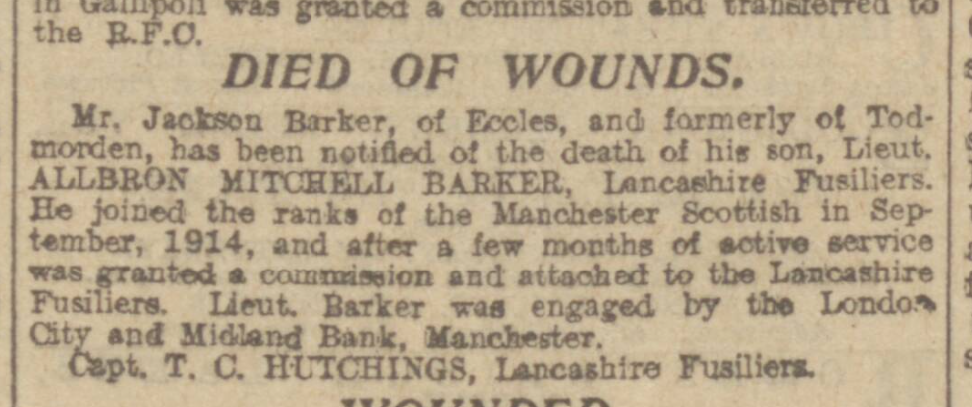
His effects, returned to his parents, included £112 of wages, and his overall estate was £484. About as much as William had left in 1869. What did his parents do with the money? There are always so many little questions you’d love to know the answer to, but know you never will. Interestingly, his employment means that he has his own page on HSBC’s portion of their website that covers their history and archival collections. His name also appears on the London Joint City and Midland Bank’s war memorial which is now living at their offices at Canary Wharf in London.
The big question though is why is he remembered on this grave? If you go and look at the engraving, his details have clearly been added later. Was it pride? Did his parents want their hometown to know about their sacrifice? Jackson’s parents were buried at Cross Stone, so their graves were hardly visible. There’s something about putting the name on a stone that faced a thoroughfare – the path to the school and along up to the parish church – and what that would mean for those who walked past and spied the name and the place of death that makes this theory attractive.
Mary Ellen died in 1923 and Jackson in 1945, and both are buried at Peel Green Cemetery in Eccles. There’s no memorial to Albion there, or even a gravestone for either of them.
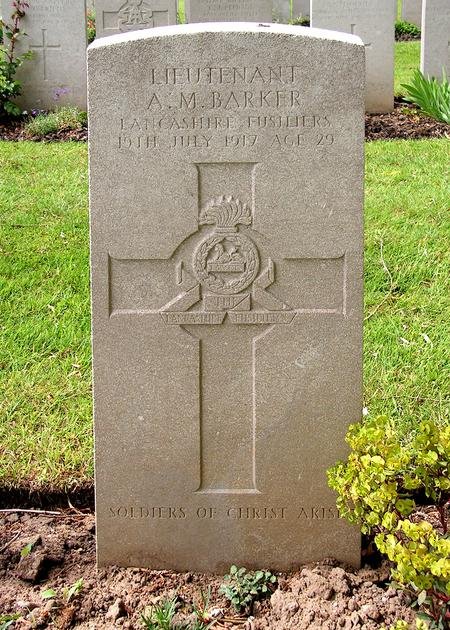
Albion’s real place of rest is Lijssenthoek Military Cemetery in West-Vlaanderen, Belgium, where the epitaph on his CWGC stone matches the one on his stone at Christ Church. If you ever travel there then stop in and visit him. If you can’t, then stop in here and remember him. After all, that was the point.