Mary Ormerod, in this triple-sized grave, gets a story page all of her own. Why? Because Mary is a unicorn in the graveyard, and because she is the quintessential “lost woman” in her family’s story.

Mary was born Mary Stansfield, in 1815, to corn miller William Greenwood of Scaitcliffe Mill and…well. This is why she’s a unicorn. Readers and researchers will know that it’s a common mystery to not know the paternity of an illegitimate child, due to the rules around the registration of births. Often there might be a bastardy or affiliation order made in the courts that might clear that up, but generally, the mother is the one we know and the father is the one we can only guess at. So Mary here is one of our rare exceptions to the rule.
John and Esther Stansfield of Ewood Hall had eight children, three of whom were girls – Betty in 1793, Hannah in 1798, and Sarah in 1806. None of the three ever married. Given Mary’s date of birth of 1815, which doesn’t change throughout her life, we can rule Sarah out as the mother. So who is it going to be; Betty or Hannah? Either one could be a contender, even with Hannah being on the slightly younger side. 17 years old isn’t too old to have a baby, after all! More curious, though, is the lack of a baptism record for Mary. That’s one way to hide a scandal from the public view…just don’t acknowledge the baby’s birth at all. But then, Betty Stansfield appears to be the only one of John and Esther’s children to never be baptised, so there are other explanations. Was Betty a bit of a rebel who worshipped somewhere else and resisted the group baptism at St. Mary’s that was held in 1806, when she would have been 13? If so then Mary was a staunch Anglican later, but never mind. Betty also died without a will or seemingly any estate to be administered, so we had to order the wills for every other siblings to see if we could find any hints, and everyone (including Hannah) called Mary their niece; so the mysterious Betty must have been her mother.
Very few of the Stansfield siblings married in the end – only two of the brothers – and so Mary grew up at Ewood Hall surrounded by aunts and uncles (and a mother) and servants, most of whom we hope loved her very much. Uncle Ashton and his wife Mary moved to Harley Bank, and uncle William and his wife Ann moved to Haslingden, where Ann was from originally. In 1841 Mary had some younger company at Ewood with her cousin Esther but it was mostly adults around her. And, of course, her father William was over at Watty Place with his siblings, living his best bachelor life (he would later say that he had “two or three natural [illegitimate] childen”) and she had a good relationship with him by all accounts, but the Stansfields kept her close. Maybe when she met her future husband, James Haworth Wilson, she saw her future opening up…

James’s story is partly told as part of the story of his family, but it’s worth retreading some of it now to explain Mary’s part in it. Whether they met here in Tod or when Mary was visiting her cousins in Haslingden, James’s hometown, is unknown – but in the autumn of 1843 James applied for a marriage license and the pair were married at the parish church there in January 1844. Interestingly, James was rebaptised into the Anglican church a few months later, presumably to make Mary and her family happy, but Mary wasn’t. Or if she was, it wasn’t here, or anywhere else we could find. James was a chemist and druggist, and bright, and about to head down to Cambridge in a few months time to study at Queens College as a “pensioner”, ie. a self-funded scholar. If Mary thought she was about to go on an adventure, she was quite possibly very wrong. There’s no record of her being in Cambridge at any point during the next five years. There’s little evidence of James being there either, to be fair, apart from Cambridge’s matriculation records and a magistrates court case from 1846 where he was found to owe a woman names Mary Ann Shepherd over £7. He might have left her in Haslingden, or Todmorden, or sent her to Whitworth to live with his family even. The last one seems unlikely as the Wilsons were an unhealthy bunch themselves. The couple never had any children, and James came home to die in 1849 from follicular enteritis, and Mary went back to Todmorden to lick her wounds amongst her Stansfield family.

That’s where she probably met Mr. Abraham Ormerod J.P., owner of Ridgefoot House and one of the three Ormerod Bros. who came from Stoneswood House on Bacup Road. His wife Elizabeth had died in January 1851, and his youngest son William a month later, and he would have been grieving them while also having two young children to look after, Hannah and John Howorth. A familiar tale! But he had the money to not require a wife to look after the children so had no pressing need to remarry beyond appearances. The young wealthy widow up at Ewood would have been an attractive prospect though, maybe in more ways than one. Certainly Mary might have initially thought twice about a man eleven years her senior. Maybe the comfort of a gentlewoman’s life was all she knew and something she wanted to secure for herself – maybe she loved him! – all sorts of maybes we can’t speculate on led to the two marrying in October 1853.

This is where we learn her father’s identity, since a marriage certificate for her and James Haworth Wilson doesn’t exist online. A number of Stansfields witnessed the marriage, but were they aunts and uncles or her cousins? The newspapers deliver a final blow; she is named not as Mary Wilson, just “Mrs. Wilson”. It was a different time…

Abraham was a good man though, later to be called “a hero to his own family”, and if Mary didn’t love him at first she certainly grew to later. The couple had a single child of their own, a daughter named Jessie, in August 1854. Their happiness was interrupted however only two months after Jessie’s birth, when a dramatic incident took place…
William Greenwood was unwell. He had experienced some “violent spasms” and was beginning to suffer from some memory loss. We can retrospectively try and diagnose him now with Lewy Bodies Disease (a mix of Parkinson’s and dementia which arrives swiftly and is resistant to treatment) but in the terms of the time he was getting on a bit and he in the early stages of senile decay. But he and Mary were close and Jessie’s birth gave him some resolve to do something for Mary, something to further acknowledge her while also looking after her interests. He mentioned in September 1854 to his cousin John Eastwood, a solicitor, that he needed to get his will made, and that he was thinking of leaving some property to Mary as a kind gesture. John told William’s brother Robert and the two quarrelled to the point of Robert “leaping upon” William. William went off to Blackpool for a few weeks and returned to Watty thinking that everything was all right…but it wasn’t. On October 2nd John Eastwood arrived in a carriage and asked William if he wanted to go for a ride. William said yes, and the two set off for Stonyhurst College near Clitheroe. They never made it. John had received his instructions from William’s three brothers: take him to “The Retreat” near Padiham, an asylum, and get him committed. The Greenwoods would allege that William was losing his mind, had delusions that Robert was poisoning him, and had threatened to shoot Robert – that he was a danger to himself and others. He was examined by two doctors he’d never met before and locked away.
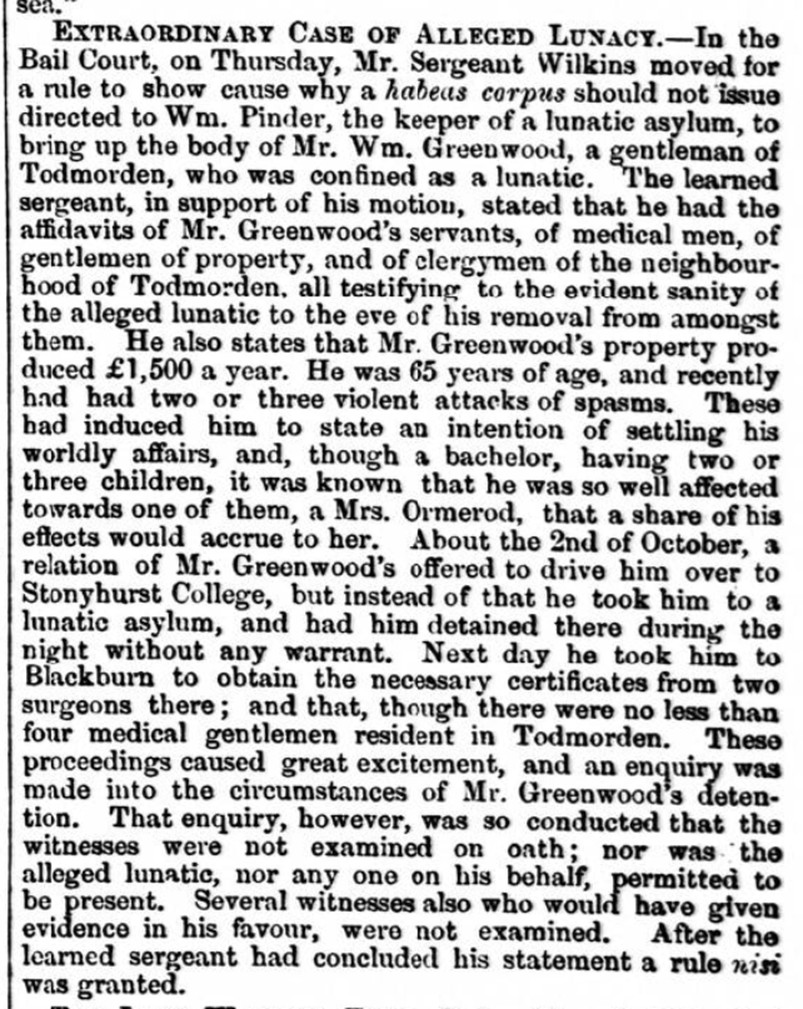
Why the Greenwoods thought this would go unnoticed escapes us now, but Mary certainly noticed, as did others, and a hue and cry went up. Dozens of affidavits swearing to William’s sanity were produced and in January 1855 the case finally reached the High Court, and a habeus corpus writ was issued. William was sent to stay in London, far away from everyone who might have a vested interest in the result, and examined by two doctors appointed by the court to determine whether he really was mad or not. He wasn’t. They were careful to give the Greenwoods the benefit of the doubt but they recommended that William be let free and allowed to have full control of his money and property and to live in peace.
The Greenwoods were not happy, although Mary would have been thrilled, and their agent wrote to The Globe in London alleging that the two medical men who found him fit had been appointed “by friends of the illegitimate daughter”. The medical men hit back and denied this. Nevertheless, this was clearly the Greenwood family’s opinion and nothing was likely to change it. In the end, William’s stay took its toll, and he died a year later in Rhyl at a cottage by the seaside where he had gone to presumably see out his final days. He never made that will. His brothers renounced their rights to act as executors of his estate and left their widowed sister to decide how to dispose of his £12,000…we’re fairly certain Mary never saw a bit of it. 1856 proved to be a hard year for her because in November of the same year her mother Betty died, and in 1857 her aunt and uncle, Sally and John, also passed away.
At least she had her own little family unit to keep her steady. She and Abraham lived together for the next 35 years, enjoying their comfortable lives. Mary was active at Christ Church and made many expensive gifts to the church, including mosaics and furniture. In the 1880s a John Stansfeld of Leeds put together a massive, all-encompassing history of the Stansfield family for Col. Robert Stansfield, his relative and patron. A copy of it is in Todmorden Library (you can also view it at home on archive.org) and its scope is impressive. A thorough tome, you’d expect. Many wealthy local Tod folks subscribed to the publication to ensure they’d be delivered one at the first printing, including Abraham, presumably as a gift for Mary. But guess what…

…Mary isn’t in it.
Because naturally why would the book include illegitimate children, unless their existence was in the past and had some relevant to the story of the surname or continuation of a branch? But imagine being presented with the history of your family only to flip to the Stansfields of Ewood and Adamroyd and see that you aren’t included. That you didn’t exist in the printed history of your own family.
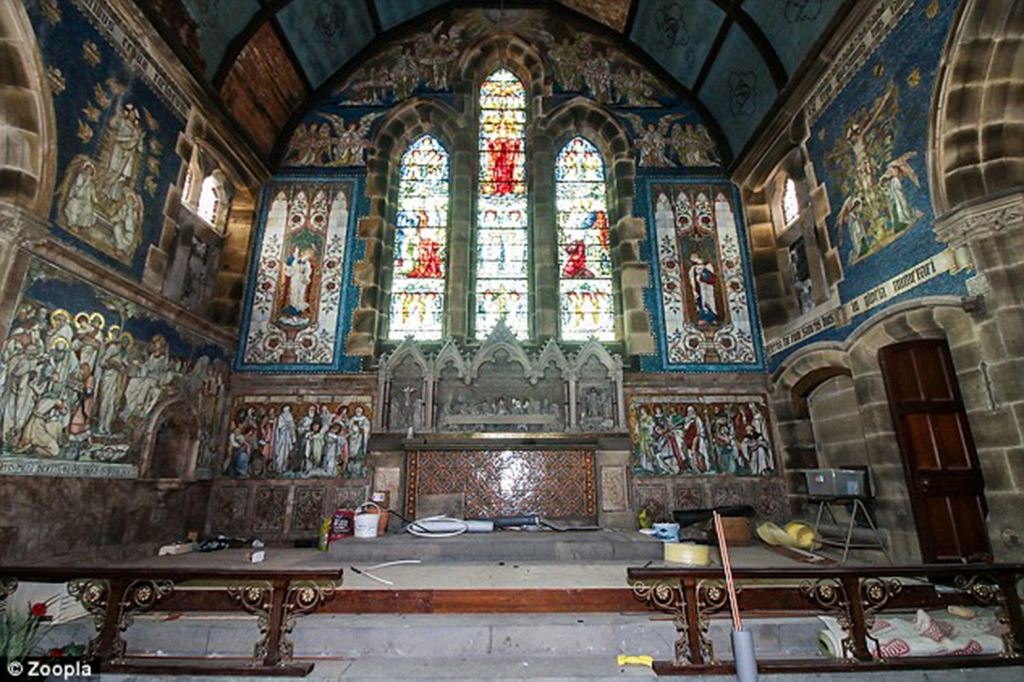
Abraham died in 1888 and Mary, Hannah and Jessie left Todmorden for Lytham to open a convalescent home in Abraham’s name. Mary was left with a £1000 a year bequest from his estate, with his three children receiving the remainder. He had left an estate valued at around £48,000 (£5.3m today) and this meant Mary was very comfortably set up between her annuity and the money she had inherited from her aunts and uncles over time. She spent some of her money on an enormous mosaic on the back wall of the extension to Christ Church’s chancel, showing the Annunciation (the angel visiting the Virgin Mary to tell her she would have a son), which was dedicated to Abraham. What a fascinating choice of subject to commemorate your husband with; did she feel as though she had also been blessed with a miracle baby?
Unfortunately, after Abraham’s death, cracks began to appear in the family. John Howorth had struggled in his adult life to find the same happiness his parents had. His first marriage, to the Rev. Augustus Conway’s eldest daughter Marian, had ended in a swift divorce after she committed adultery on several occasions with a certain Lionel Edwards, the son of another local vicar, Rev. John Edwards. He married for a second time in 1880, this time to Marianna Hinchcliffe, the daughter of Abraham’s colleague on the benches George Hinchcliffe J.P. of Stoodley Grange. The Hinchcliffes were followers of Emanuel Swedenborg, an 18th century Swedish theologian, who believed in spiritual marriage and a spirit realm between Heaven and Hell, and whose beliefs would have been anathema to devout Anglicans like Mary and, as it turns out, Hannah and Jessie. By the time of Abraham’s death John and Marianna had moved to Southport and were supporting a Swedenborgian church there, and while Mary and her daughters spent their time and money raising funds for Christ Church, John was doing the same for his own church far from home. Marianna died in 1892 and John remarried in the summer of 1894. When he died five months later, the bombshell dropped: he had left half of his own £40,000 estate to his new wife, and the remainder to friends, cousins (three of Peter Ormerod’s four children; what on earth had William Ormerod done to offend his cousin?!), and a few bequests to some non-church organisations. Abraham’s wish for the siblings to inherit a portion if there were no children had been ignored.
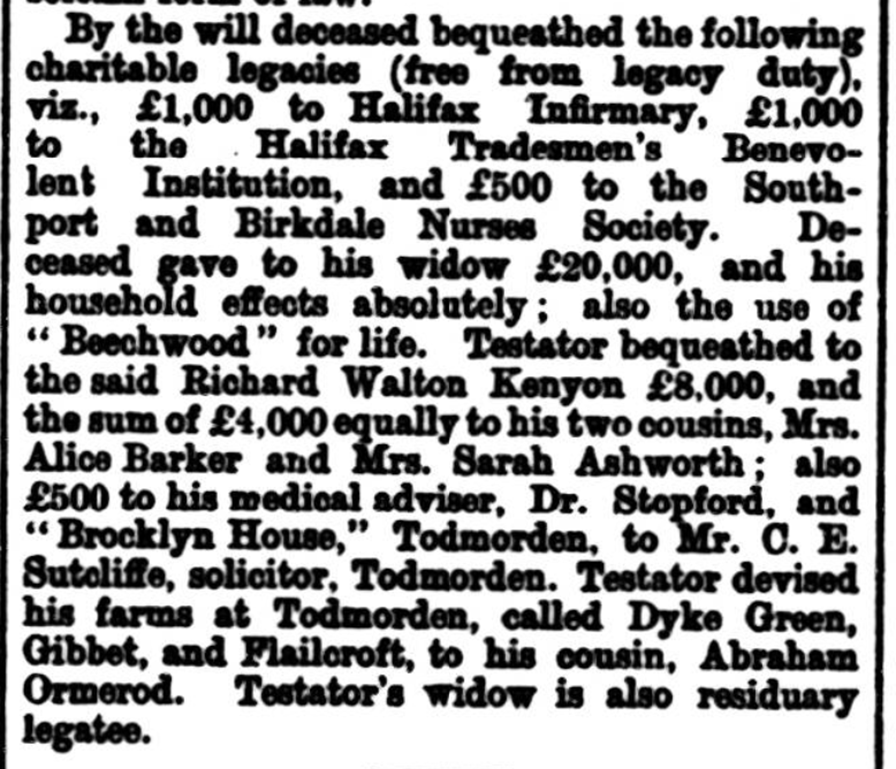
In what must have been a shot across the bows to Margaret, the new widow, Mary and her daughters sent their solicitor to John’s funeral. A probate hearing was not held until the following June, when the sisters formally contested the will, alleging that John had not been in his right mind and had been under the “undue influence of his new wife”. At the hearing, however, at the last minute, they came to an agreement with Margaret, and dropped their case. One has to wonder what part Mary played in this process. On the one hand, she had seen how money can destroy sibling relationships and probably felt that doing this would be the final blow to any fond memories the girls had of their brother…on the other hand, she knew what it was like to have to sit by helplessly while something which had been promised to you ended up in the hands of others. What was her advice? We’ll never know. But she updated her will a week after John’s death to leave her entire estate to Jessie, with both Jessie and Hannah acting as trustees and executrixes.
(And in case you wonder what Margaret Ormerod, nee Thornton, did with her tens of thousands of pounds…nothing. She remarried a few years later, to an Anglican vicar from the Isle of Man, and when she died in 1903 her estate was valued at around £21,000. Maybe the compromise was that she did nothing with it.)
In 1896 Mary and her daughters left Lytham St. Anne’s for a more rural, quieter existence in Caton. Her final two years of life at the “Hermitage“, on the banks of the river Lune, must have been idyllic.

When she died in 1898 she was brought back to Christ Church to be buried with Abraham, and the papers spoke of her in the most glowing terms. Someone with a long memory even mentioned her first marriage all those years ago. And, of course, she was named as a niece of John Stansfield of Ewood Hall. But that’s all – like we said, some mysteries you just can’t solve with the evidence you have before you. The account of her burial which was published the week afterwards sounded beautiful; around her lead coffin, inside the wooden shell, were placed purple cloth and ferns, flowers, and mosses at her sides and at her feet. That’s the very last thing we learn about Mary, that she was someone who must have loved nature. Not just fancy ladylike gardening but real, wild greenery.
So there’s Mary Stansfield for you – from riches to riches to riches, widely respected and loved, but erased from the official history of her family.
All the other Stansfields in this story are buried in the private area of Christ Church. Interestingly her grandfather John was the very first person to be buried here at Christ Church in April 1825.