Three generations of women, linked by one man, all resting here with him. Maybe it was a case of safety in numbers?
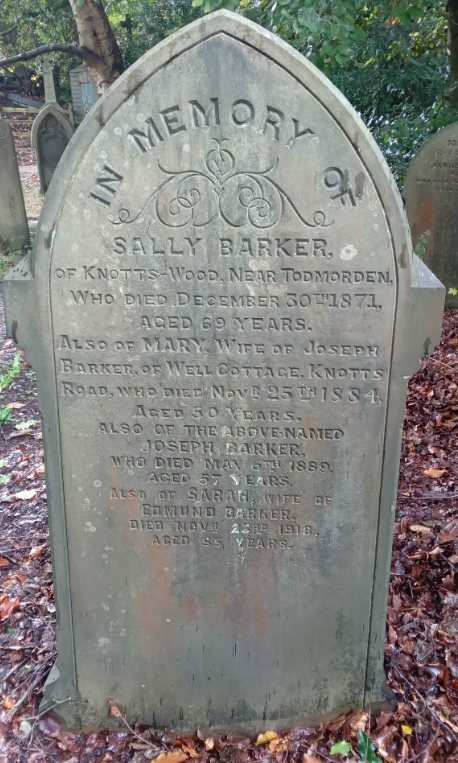
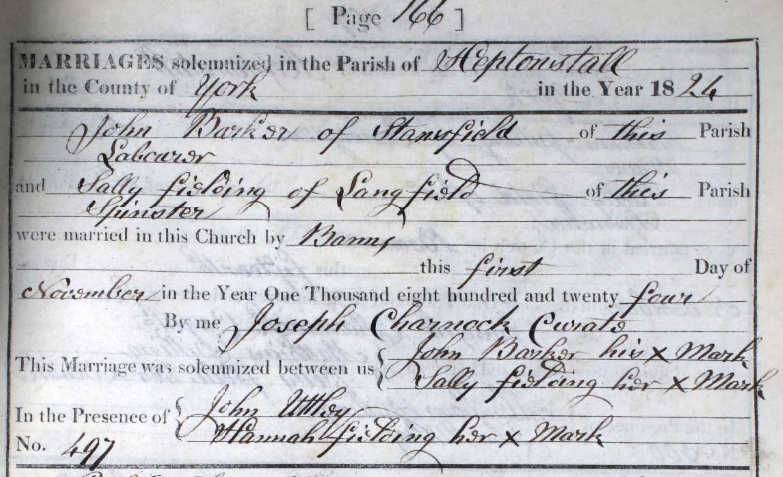
Sally Barker, the first person buried here, is the matriarch. She was born Sally Fielding (or Fielden) in 1802, and married John Barker at Heptonstall in 1824. He was an agricultural labourer a few years older than her, and on their marriage he whisked her away to the hills above Lydgate to live at Bank Bottom, where he worked.
Sally’s life was more or less that of a farmer’s wife, living on the hills and making sure that the family work was done so John wouldn’t have to do anything else when he got home. Some of that family work was producing more little labourers and she succeeded in raising seven children to adulthood. One of them was Joseph. The Barkers were at Bank Bottom on the 1841, 1851 and 1861 but not long after 1861 they would move down towards the valley bottom. That’s where John died in 1864, at Barewise Terrace near Fidler’s Well. You now know the area as the allotment built into the foundations of some old houses just past Robinwood Mill on Burnley Road. He was buried at Cross Stone.
In her widowhood Sally was supported by her unmarried sons Esau and Robert. All four of the Barker boys – John, Joseph, Esau and Robert – had become stonemasons and had (or later would) all settled on Knotts Road with their families. On her own death in 1871 she was buried here, presumably because the family grave at Cross Stone was full. It might be coincidence or might not that the grave next door also has links to a stonemason; is this a miniature “stonemason’s row” tucked away near the school?
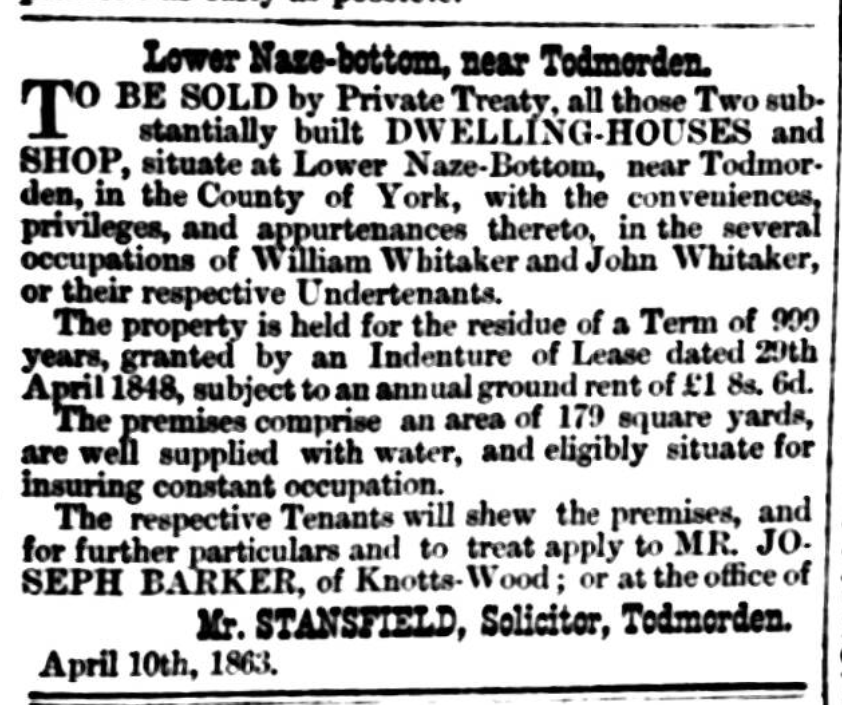
Joseph meanwhile was proving to be a very successful mason as well as a contractor hiring out masons under him. His marriage in 1856 to Mary Whitaker would have also brought some success. Mary was from Haslingden originally, the second eldest daughter of blacksmith Edmund Whitaker and his wife Rachel. The Whitakers had moved from Flax Moss to Nazebottom, just below the railway viaduct in Lydgate and later known for Arch View Picker Works, and seem to have taken up residence in properties that belonged to the Barkers! Joseph was embarking on a spate of house building in Lydgate and on Knotts Road in particular. If you live up there, you might live in one of his houses…
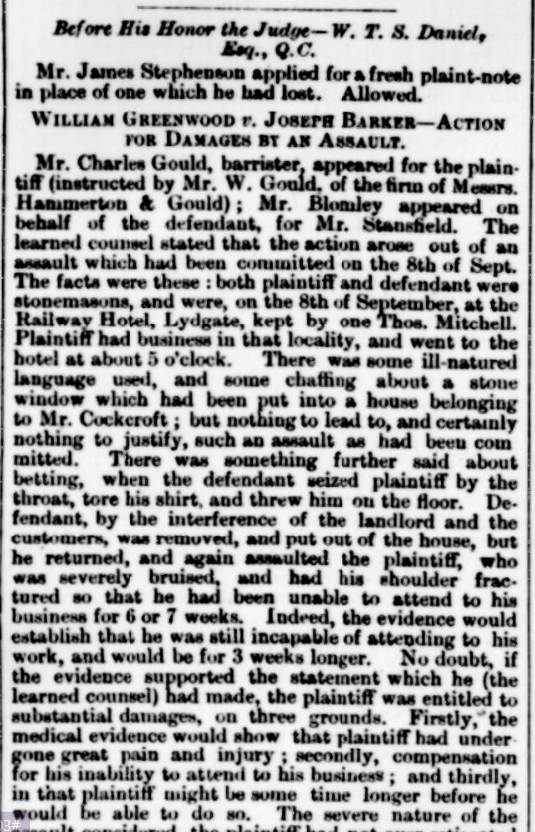
Joseph was a hard worker and a success in his field, but he was possibly a hard man to love. He had a habit of getting into fights, some of which ended with him viciously wounding his foe, and instigated as many as he defended. One early encounter was in 1870 with fellow stonemason William Greenwood, at the Railway Inn, and ended in Greenwood suffering from a broken collarbone and unable to work for months afterwards. Joseph had to pay £25 in damages and £13 in costs; a serious sum of money in those days. One has to wonder what his home life was like, although nothing was ever brought before the court or alluded to in any of his other appearances as evidence for him having a violent temper.
Amusingly, after being arrested for being drunk and disorderly at the Railway in 1881, Joseph asked the magistrates to deal with him leniently as it was his first time! Another incident involved him being targeted by a man and woman trying to run a honeypot on him to pick his pockets but ended with them fighting and the couple making off with his pocketwatch. At the trial he had to answer questions about whether he had offered the woman money in return for the promise of sexual favours, whether he had unbuttoned his trousers, whether he’d told her that he had plenty of whisky and soda water at home and that she could sleep in his hayloft…poor Mary, having to listen to all this. But times were different and it was hard to get a divorce back then, and harder still to move on from one. We only know of two contemporary divorced women in our Christ Church research so far and both were childless and had money behind them. What chance did Mary have?
Instead, she swallowed her pride and looked after the house and their five children – four daughters and a single son, who was named Edmund after her father. Edmund also became a stonemason but was a rather more stable and well behaved one than Joseph had been which must have been a relief to Mary. She didn’t live long enough to see him married and whether he continued to behave; she died in 1884 and was buried here with her mother in law, and Joseph followed her in 1889. Edmund’s first and longest marriage came in 1890 when he married Sarah Sutcliffe of Royd House Farm, but formerly of Fielden Terrace in Lydgate – best known as the famous “Bowed Row” that stood over the river between Robinwood Mill and Fiddler/Fidler’s Bridge.
Sarah was a cotton spinner whose father, Abraham, had gone from a cotton scutcher to a farmer, making the move from the valley bottom up to Royd House overlooking Scaitcliffe and, if you stand there today, the other side of the valley where Ashenhurst now stands. Now it’s just the bare foundations with a tree growing out of it but once it was a farm, and Abraham did well for himself to get up into the fresh air (even if it would have been very…bracing…in the winter). Sarah was his eldest daughter and would have been busy outside of work with helping her mother Betty with her eight younger siblings. This figure grew by another two after her brother John’s wife died and a niece and nephew joined the mix.
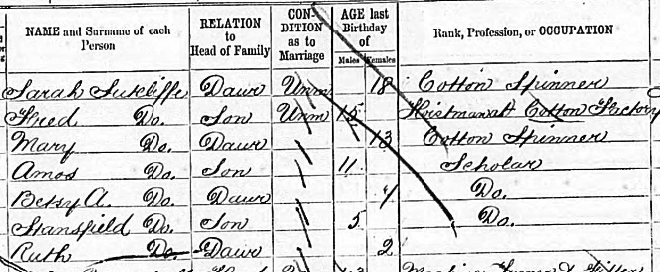
Marriage to Edmund brought escape as well as a drastic difference, in the sense that the couple had a very different family situation. They only had one child, a son named Fred, who was born in 1894 and was named after Sarah’s younger brother who had died in 1891.
The Barkers continued to live up on Knotts Wood and by 1911 had a new addition to their household, Sarah’s niece Sarah Annie Greenwood. She was the daughter of Sarah’s sister Ruth and her husband, Fred Greenwood, who in 1911 were living in Burnley. Sarah Annie had been born just over a year after their second child and perhaps it was easier for Ruth to manage without two infants, and Sarah stepped in. Maybe Sarah had had problems with fertility and was keen to “have another baby” even though by this point she was 47 years old. Whatever the reasons, Sarah Annie’s presence would be some small comfort when Private Fred Barker, 23 years old, of the Duke of Wellington Regiment, died in July 1916, eight months after enlisting.
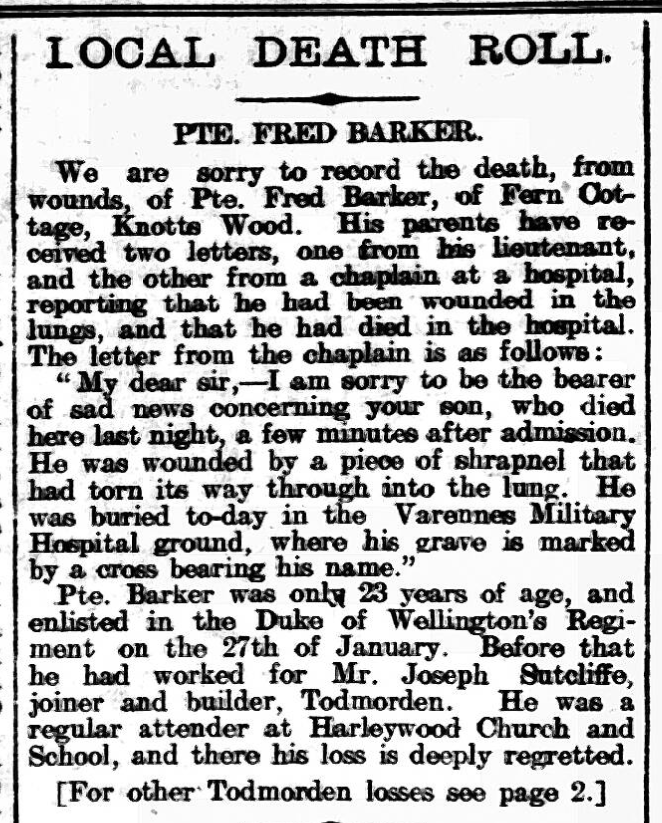
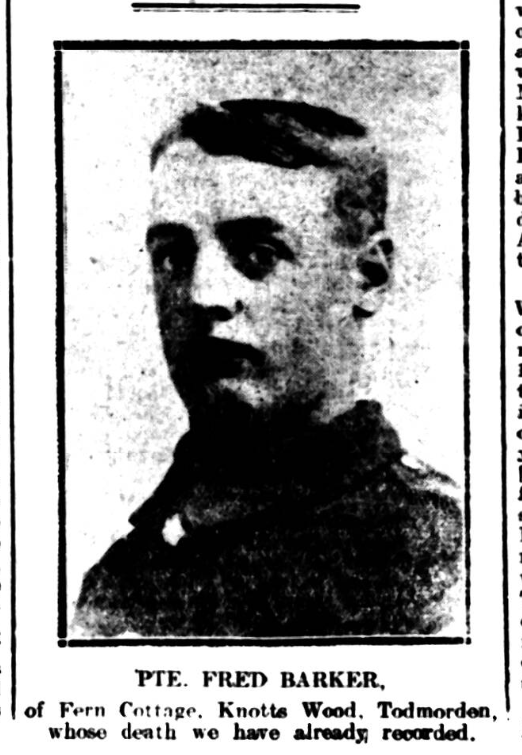
Is it a coincidence that Sarah Barker died only two years later? Maybe, maybe not. Fred’s loss was so painful that his name never made it onto this gravestone; unusual, as there are easily 35 or more stones at Christ Church that explicitly remember a fallen serviceman whose remains are in a corner forever England…but not this one. Fred is buried at Varennes and remembered on the memorial at Thiepval.
Edmund and Sarah Annie were left to console each other, and in 1921 it was just the two of them at Fern Cottage. Down Knotts Road there was another Greenwood family though – 61 year old widow Mary Ann Greenwood and her 38 year old daughter Florence, a cotton weaver at Frostholme Mill. Edmund found love again with Florence, nearly twenty years his junior, and they married in 1922. He died in 1928 and is buried elsewhere.