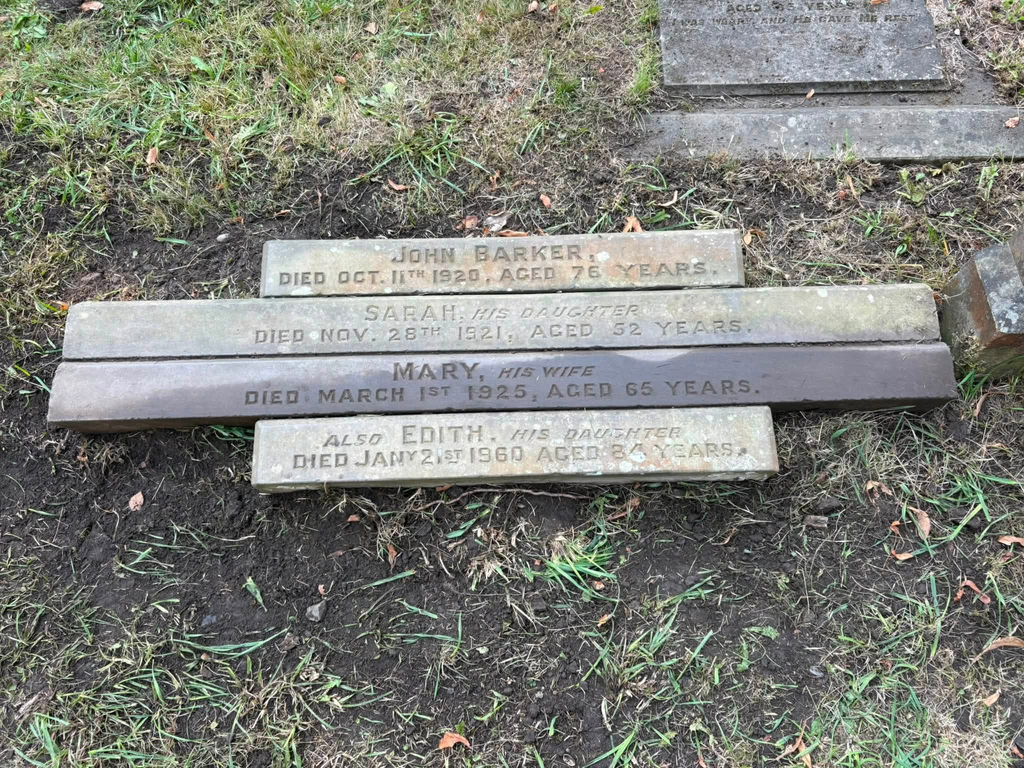
This is a story already half-told, at a grave further back in the yard – a now-flattened ledger commemorating Susanna (Marshall) Barker and some of her children. That stone also remembers the three children of John and Mary (Smith) Barker, who are buried here. A first wife who looks after her replacement’s children in death; and here, a second wife who helps look after the children of her predecessor. Mary’s sidestone had sunk so far into the earth that no one in 2006 could find it, and we only found it due to unseasonably hot weather this summer causing the earth to harden and recede enough for us to glimpse the top edge of it. Now all four Barkers are brought back into the light, let’s hear more of this family’s story.
John Barker was born in 1843 at Platts House, the son of Joseph and Susy (Astin) Barker. Joseph was a coachman whose client was the famously crotchety and difficult Samuel Fielden, one of Honest John’s sons. Platts House was his home before Centre Vale, holding the post before George Brammah took over. Yes, everyone here is connected…that’s one of the great mysteries of a graveyard. The more you research these people the more it hits home…but we digress. Joseph was a servant but he made sure his children had chances and John here was working as a book printer by 1861. He married Susannah in 1866, the couple had an impressive nine children, and when she died in 1885 he was left with the six remaining children and the usual dilemma: mourn or move on?
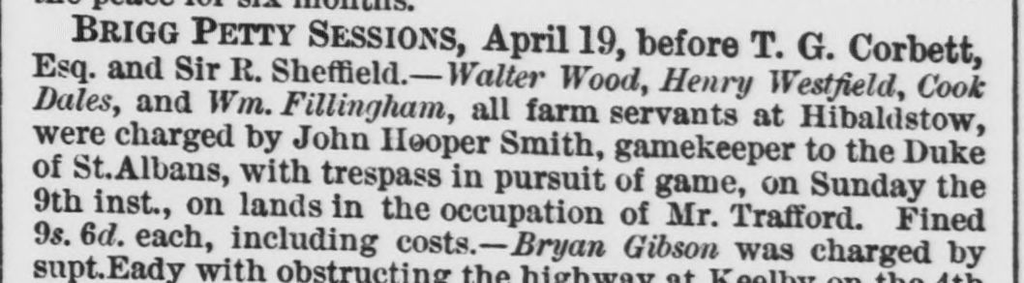
John moved on. Enter Mary Smith, born in 1860 and sixteen years his junior. Mary had been born in the delightfully named Turner’s Puddle in Dorset, her father James Hooper Smith being a gamekeeper who had himself been born in the less delightfully named Piddletown. His work took him all over and when Mary’s mother Sarah died in 1865 the Smiths were living in Lincolnshire. John was left with two children, Charles and Mary, to look after. Fortunately he was working for someone rather grander than a Fielden son – his employer was the 10th Duke of St. Albans, William Amelius Aubrey de Vere Beauclerk. He didn’t need to remarry just to find someone to help raise his children while he worked! A house servant named Elizabeth Gould helped out until his remarriage in the early 1870s.
It’s no surprise that Mary herself became a house servant, since that was the world she grew up in. She ended up going from rural Lincolnshire into the big city – Pendleton in Salford, specifically, working for solicitor Walter Palmer Fullager. When the Fullagers decided to move to Lytham she didn’t go with them, but instead came to Centre Vale. And there, she met the older, maybe interesting, definitely in need of some serious assistance John Barker, and the rest is history.
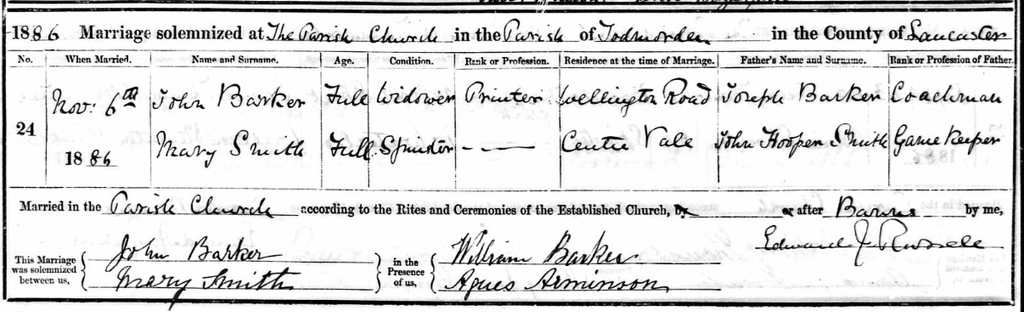
John and Mary were married in November 1886. They would only have three children together, and we know those three children’s fates…two dead within a few weeks or years, and one dead in her early 20’s. John’s other six children would be Mary’s supports and she mothered them as best she could, even the ones who were not that far off of her own age – Emily Barker was seven years younger and would have been 19 when her 26 year old stepmother appeared on the scene! John’s printing business was going well and he was also a local delegate from the Co-operative Society to their national insurance conference, a member of their Education Commitee, one of the managers overseeing National and Shade Schools, and eventually President of the Todmorden Church Institute; a busy man in other words. Mary, meanwhile, helped host lunches and teas and other soirees at Christ Church.
The Barkers experienced everything a family could within the span of their lives. Every single one of John’s children, with both Susanna and Mary, are buried at Christ Church, at all ages. John and Mary saw their granddaughter’s death outside the National School and that granddaughter’s father’s death in WW1. They had a daughter who never flew the nest. They had a daughter who preferred to board with others than live with her father and stepmother. They had a widowed daughter and her daughter move back home. They saw a daughter take on running the Women’s Education Committee at the Co-operative Society, following in her father’s footsteps. They even had a daughter marry a weaver who briefly took a turn as the National School’s caretaker…and yes, as some of those other stories get told we’ll link them from here. Everything is connected! We keep saying it for a reason!
John died in 1920 and Mary in 1925, and their stories ended there – but there’s two other people buried here too…
The Daughter Who Preferred To Board With Others
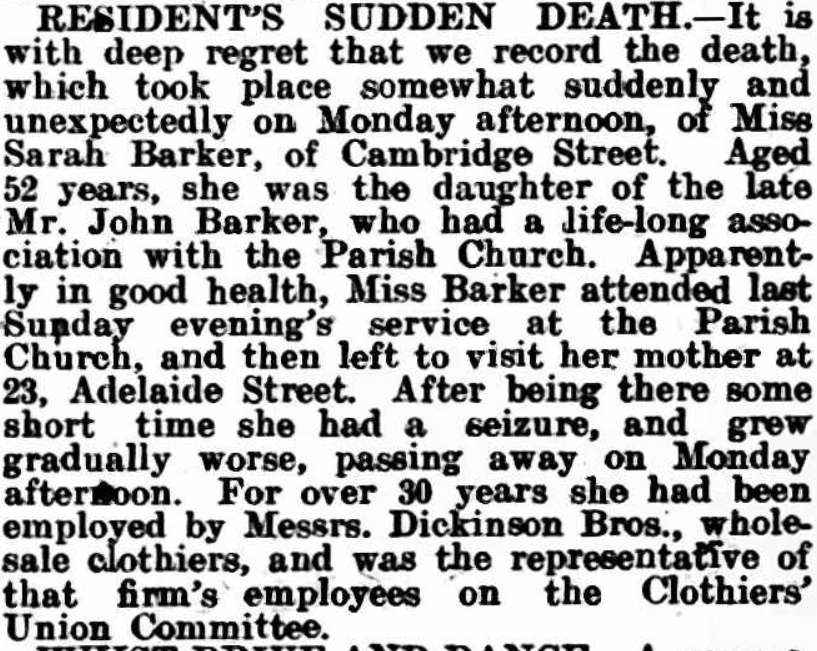
Sarah, John’s second daughter, flew the nest early. Why, we wonder? Probably just the desire for freedom we all have, and maybe a little bit of determination to try to not have to rely on a husband. Her sister Emily was quietly sympathetic to the suffrage movement, after all, having invited one to speak to the Women’s Education Society members! She was also interested in the trade union movement, just like Emily. The problem is that she flew so effectively that we can’t find her for a 20 year span. When she does reappear in 1901 she was boarding with newly married Samuel Stansfield and his wife Betsy. She stayed with them for the next 20 years. By 1911 the couple had welcomed a son named Walter, and in 1921 it’s still Samuel, Betsy, Walter and Sarah. Sarah’s work was in fustian finishing. One day in November 1921 she went over to visit Mary and her sister Susanna at their house on Adelaide Street and was suddenly hit with a seizure, dying shortly after.
The Daughter Who Never Flew The Nest
Edith’s life, meanwhile, didn’t really begin until her father died. She was a cotton weaver and was involved in the church and Sunday School, and it was there that she spent a great deal of time with her near neighbour Mary Crowther who is buried under the Woodlands extension. As time went on she found some work helping John in the letterpress business, but after his death she moved in with Mary and became her paid housekeeper. This arrangement continued all the way until Mary’s death in 1956, after which Edith moved in with her twice-widowed sister Susanna Fielden. Edith died at Halifax Royal Infirmary in 1960 at the age of 84. Even though she and Mary are separated by a distance here in the yard, we can preserve their link through this story.

This set of stones marks a family who, when you look at our Ancestry tree, is populated with names who have images of gravestones attached to every single one. No “and who was buried at ____” inscriptions here! Many of the other stones are grander than these but that’s not what matters. As always, what matters is what you learn when you don’t just stop at the fancy stones and give equal attention to the plain ones…
Thank you for giving all these people the respect they deserve in a world that forgot them. Best wishes. Norah.