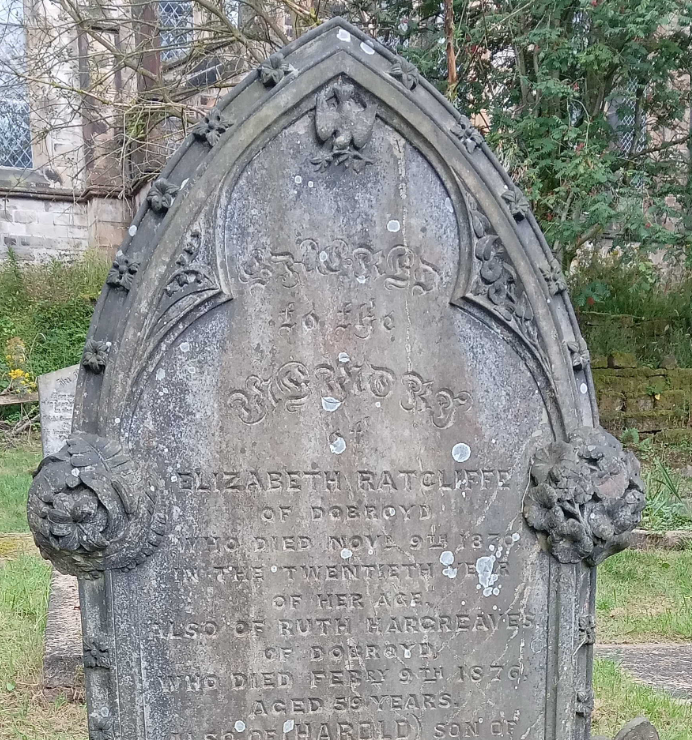
This is a “busy” gravestone, and we’re going to first focus on the first two people named on it. A girl and her aunt whose stories are both short, but for different reasons. So let’s look at the top half of the lancet, admire the subtle dove that you might miss because of the larger knots of flowers further down, and find out more.
You may have read about Joseph Ratcliffe before; this story starts with his younger sister Ruth. Ruth was a heald knitter – someone who knits the loops through which warp threads for weaving will be drawn. This is an occupation that survived the coming of power looms and must have been the most tedious, awful work; take it from this researcher who knits and weaves! Think of how broad a bolt of woven cloth would be…then think of how many strands the weave would need to be for medium to fine woven cloth…then take that imaginary number of threads that would run the horizontal length of the bolt of cloth, and at least double if not quadruple it. If the process of weaving wore these woven healds out, then more must be made. You couldn’t pay me enough. They may not have paid Ruth enough either. In 1841 she and her sisters Hannah and Margaret had gone to Saddleworth to work as heald knitters, with Margaret apprenticing to the role. By 1845 she was back in Todmorden though, which we know because that was the year she got married.
Enter James Hargreaves. Already calling himself a manufacturer, he was the son of a Heptonstall farmer who also made money as a hand loom weaver in the days when you could do so. By 1841 the family were down at Roomfield Lane where Edmund was doggedly still hand weaving cotton. James was looking towards the future though. Where was he looking, though? James is a bit of a mystery as he seems to have mostly made his fortune outside of Todmorden, although in 1861 when Parker Astin at Canteen Mill in Lydgate went bankrupt, James was one of the mill’s trustees in proceedings. But that’s hardly very far away from Todmorden! Poor Ruth is living with her family in 1851 and entirely alone in 1861, in a cottage at the bottom of Dobroyd Road, with no sign of James and no sign of children. What was going on?
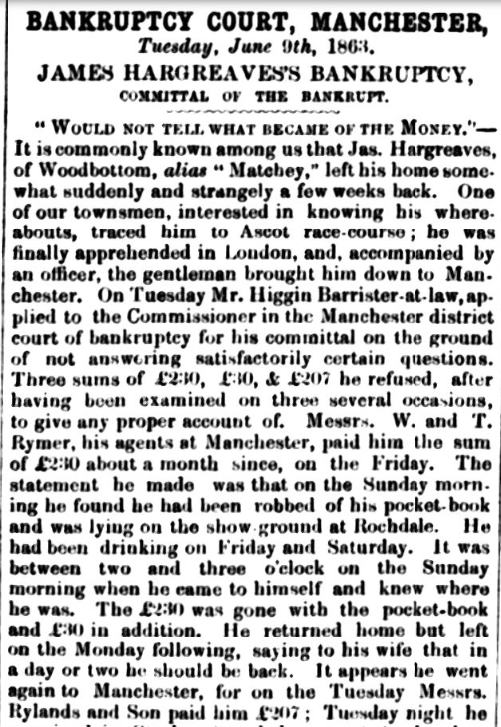
James eventually took over the running of Woodbottom Mill off Hollins Road, in Walsden, in 1863. Things immediately went horribly wrong. No surprise, given it was the middle of the American Civil War and the cotton supply was poor in both volume and quality. James seems to have had some sort of breakdown and told a complicated story to Ruth one evening about having been robbed of £230 in Rochdale following a few days of drinking, but asked her not to tell anyone. Shortly after he went to Stockport but then suddenly changed course and went to London, and blew another £207 on the horses at Ascot! He ended up in debtor’s prison after being declared bankrupt and then refusing to answer questions to the satisfaction of the judge. It took well into the next year for him to be released, and all his assets were taken and sold to repay his creditors. What happened to him afterwards is unknown but Ruth considered herself a widow, and on the 1871 Census describes herself as such.
In the meantime…brother Joseph had a daughter named Elizabeth, as we know from his earlier story. Joseph’s first wife Maria died in 1852 and so when he died in 1863 there were some children still not quite of age to go out into the world on their own, and his second wife wasn’t interested in taking them on. Elizabeth was eleven and her sister Sarah was fifteen, and both of them went to live with Ruth. That might be where Elizabeth learned to be a heald knitter…
Elizabeth sadly developed phthsis and after four months of struggling through it, suddenly developed a five-day-long nosebleed that pushed her over the edge. She died at the house at Dobroyd with her older brother Edwin at her side. She was only 19.

Sarah stayed on with Ruth. Ruth’s life didn’t go much further, and in February 1876 she died from bronchitis and was buried here with her niece. If we had any doubts that she had outlived James – and it was fair to have them, men did sometimes just go off and leave women to decide whether they dared pretend to be widows and try to make a new life – as far as the government were concerned when it came to her will and estate she was a widow. Still, her death certificate gets one last dig in at James via Sarah, who was either a very loyal niece or simply didn’t know – his rank and profession is unknown.

She left about £300 behind. She left Sarah behind too, and her story follows on here.