A few rows downhill from the once-imposing Hardman monument stands a not inconsiderable ornamental ledger with its own links to that influential family. Meet the Pickles and Midgleys; we’ll tell you what we know, but we don’t know everything…
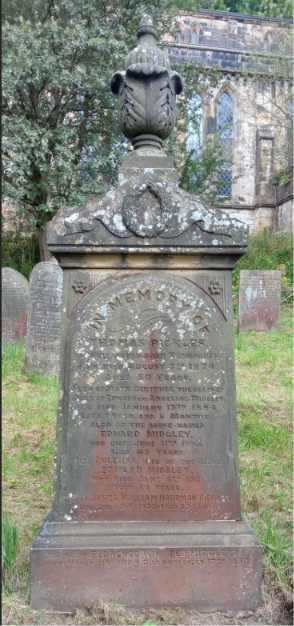
The story technically starts with Angelina Hardman, daughter of Dr. James Hardman, whose story we’ve already told. Angelina was the 7th of 9 children and grew up in comfort. The greatest flex a grown child who lived at home could make was having no occupation on the census, and Angelina was able to get away with it, along with her other sisters. In 1863 she traded one comfortable life for another when she married local coal dealer Thomas Pickles.
Thomas was one of the children of William and Hannah Pickles of Hathershelf, the other side of Mytholmroyd. William was a successful farmer who expanded out into coal along with his brothers Thomas and James. His sons soon began to follow suit. In 1851 William was a farmer of 38 acres employing one man, and his sons all farmer’s helpers, but by 1861 he was farming and dealing in coal and employing six men. Thomas was still a “farmer’s son” then, but by 1863 had joined up and become a dealer himself.
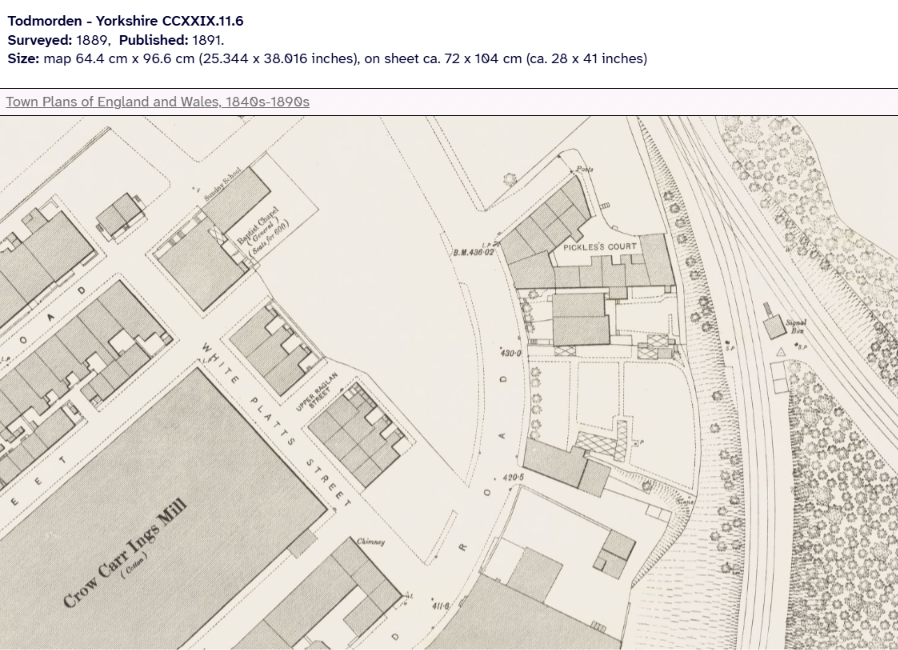
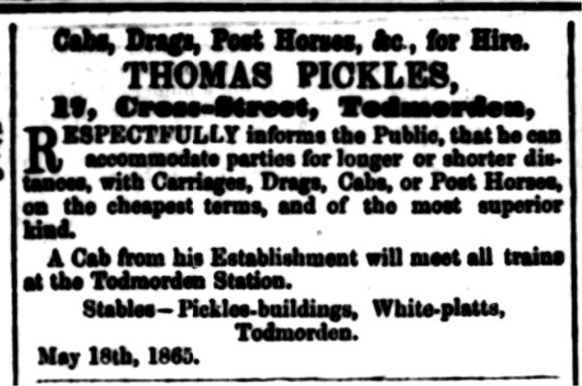
The couple settled at White Platts but more specifically at Pickles Court. Pickles Court is still there although it’s now newer-built flats and not the horseshoe of terraces it was back then. Named for the family? Probably. Other Pickles siblings were living nearby on Wellington Road. Thomas was not just dealing in coal now but also had a cab and carriage hire business bringing in income.
If Thomas and Angelina were happy then there were no children to show for it, and over time Thomas began to appear here and there in the newspapers either being owed debts by customers or owing debts in the form of fines for being drunk in public. By 1871 Thomas had disappeared entirely and Angelina was living at Pickles Court with his brother James, who was now also a “coal depositor”. Angelina’s occupation? “Wife”. Not of James, obviously…but her husband was nowhere to be found. The last we’d seen of him was in 1870 when he went off to Bury for the fair and came home drunk, having not bought a ticket, and was apprehended trying to crawl under some parked railway carriages to get out of the station area unobserved.

We know he was back by August 1874 as that was when he died, only 30 years old, at White Platts. His occupation had been demoted to carter and his cause of death was delirium tremens. The drink had gotten him. Some siblings and his mother had already been buried up at Cross Stone but Thomas was buried here, possibly well away from them in their eyes, or maybe because Angelina still loved him. Who knows?
Angelina was now a childless widow and in no rush to remarry. Why would she? She was a Hardman! And thank god for that, because Thomas had died without a will and left her with business debts. The estate was initially settled in January 1875 and valued at under £300. Angelina rose to the challenge and now worked to settle all outstanding business as best she could, which didn’t just involve going to court to sort things with creditors but also to call in debts owed. One of these debts involved money that had come from her father’s estate (James Hardman had died in 1873) but had not been handed over by the agent prior to Thomas’s death. It seems things were finally a mess, and it’s hard to figure out precisely what was happening in court, but what started as a payment of £97 turned into £12, and ultimately £9. It didn’t matter that the inheritance was hers, what mattered was that the money was in the agent’s hands before Thomas died, and so it was legally Thomas’s money and so had to be accounted for in order to settle his posthumous debts.
Those were the days eh?!
Angelina didn’t lose everything – her team of horses came second place at the Holme Chapel Agricultural Show in 1877! – but it’s no wonder she wasn’t in a rush to remarry. This held even though in the summer of 1876 she welcomed her first child, James William Hardman Pickles. His paternity is unknown. James Pickles, Thomas’s brother, stayed on living in the White Platts area for some time but left for Brighouse to become a farmer some time after the business failed in 1878. His last appearance in Todmorden’s newspapers is 1879 when he was – like Thomas – arrested for public drunkenness.
Angelina remarried at last on March 16th 1881. James died on March 20th at the age of 30, the same as his brother seven years earlier. His death registration isn’t digitised so we don’t know the cause and there are no coroner inquests reported in the newspapers relating to his death. Could be coincidence, could not be. We told you we didn’t know all the answers.
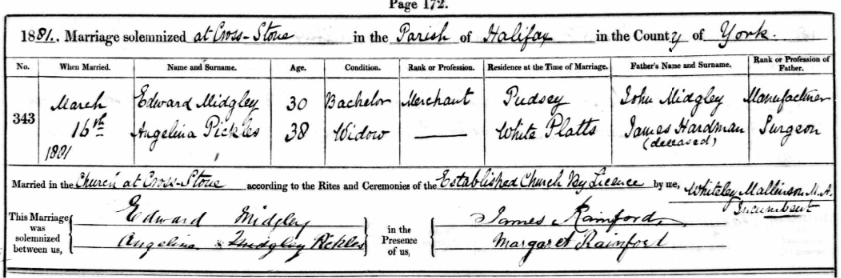
How about this remarriage then? Here we introduce another inhabitant of this grave, Edward Midgley. Edward was nine years Angelina’s junior, born in 1850 in Ovenden to stuff manufacturer John Midgley and his first wife, Mary. Stuff, for the uneducated in textile history, refers to a variety of types of woollen cloth woven from combed wool and used for different purposes. John was beginning his climb around Edward’s birth, employing six men. Ten years later Mary had died, John had remarried, and the Midgleys were now living in Idle near Bradford where John now employed 43 men! Edward was trained up as a bookkeeper in his father’s business but would later, as we can see above, start styling himself as a merchant. Edward was now dealing in cotton yarn, though, and on the 1881 Census is named as a cotton warp agent. For all his success it’s worth noting that his eligibility to vote was based not off of land ownership of his own, but from Angelina’s shared ownership (part of her inheritance) of the Black Bull Inn at Gauxholme.
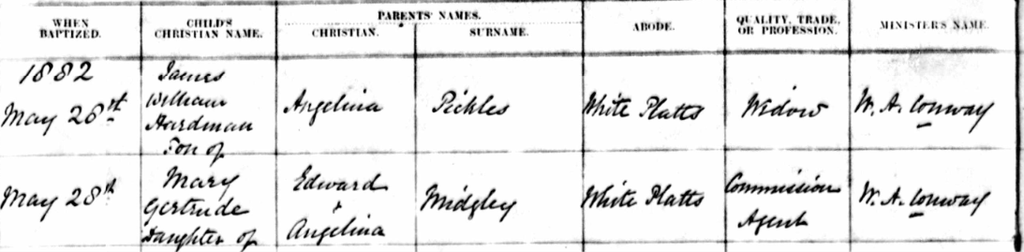
The Midgleys were still living at White Platts and soon the couple would celebrate their first child together, a daughter named Mary Gertrude. She and her older brother James were baptised together at Christ Church in May 1882.
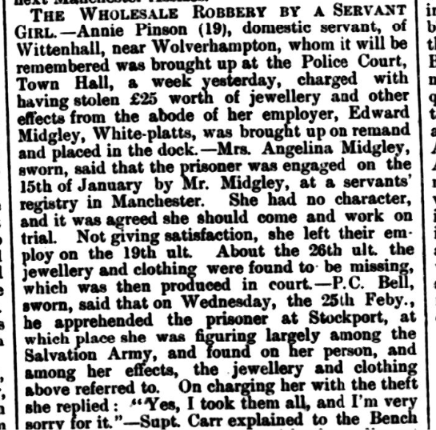
Mary Gertrude’s life was short, and when she died in January 1884 Angelina must have despaired. Not only had she and Edward lost their daughter, she was at that point about seven months pregnant with their next (and last) child together, Florence Winifred. Edward could see that his bereaved and exhausted wife needed some help and so he hired a female servant from an agency in Manchester two days after Mary’s death. The servant, Annie Pinson from Wolverhampton, proceeded to steal £25 worth of jewellery and clothing from Angelina. The losses were only noticed after Annie’s dismissal for poor performance a month after her arrival. Talk about kicking someone while they’re down…
Florence was born at the end of March 1884 and for the next nine years life progressed peacefully for the Midgleys. They moved around a bit though, first to Ashenurst where they were living in 1891, and then to Owlers in Lydgate, at the end of Church Road and within spitting distance of All Saints Church at Harley Wood. It was here that Edward died in June 1893. His cause of death is cropped out on his death registration but we can see “exhaustion” and that tells us plenty. Angelina buried him with their daughter and her first husband, and retreated into widowhood for good.
James meanwhile found his niche in butchery. The family moved back towards the town centre and settled at 1 West Street where he apprenticed under Thomas Butterworth. When Butterworth retired James took the business on and made a decent job of it. Florence found work as a milliner and Angelina kept house. James’s professional life was not without its dangers; forget the bovine TB we’ve talked about in other stories, there was also the more obvious danger of a frightened angry large animal at close quarters. In 1906 he was crushed by an unidentified large animal while trying to get it out of a cart and into his slaughteryard and broke his wrist and was “crippled” in his left arm afterwards. This came in handy when WW1 rolled around, as it helped to earn him an exemption. What the neighbours at 3 West Street must have thought, and how he and his mother and sister must have felt, when those neighbours lost their son a few months later…well, we can’t know can we. It’s another question we can’t answer with anything other than guesses.
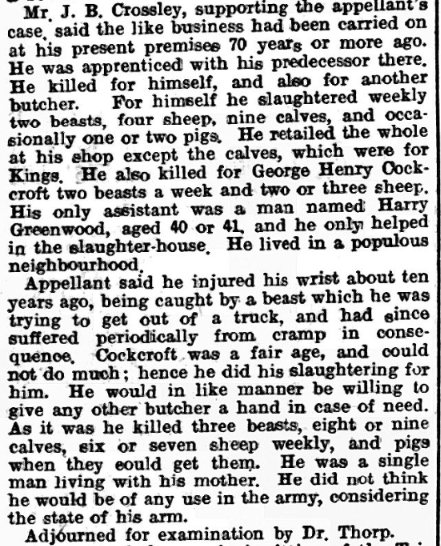
Florence, meanwhile, found work as a clerk to the Town Council for 25s a week during the war, and it’s interesting to notice James’s assertion at the tribunal that he was a single man living with his mother – no mention of his sister? She was certainly living at 1 West Street too at this time! But a sister who earned money might have harmed his chances of staying home.
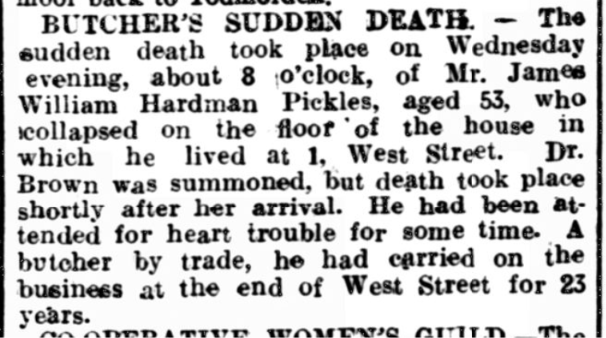
When the war finished Angelina’s health began to suffer and in January 1921 she died at the age of 80. She had lived longer than both her husbands put together. She left behind a substantial estate and while James continued on as a butcher Florence chose to take a step back from work altogether. They also took on a live-in maid, widowed Georgina Kaye, who’s buried at 4.43 with her husband. The siblings were not well though and Georgina probably had more than she expected on her plate. James had developed trouble with his heart and in 1929 he died suddenly at the age of 53. Florence followed him a year later at the age of 46. In her case it was heart disease and tuberculosis. Angelina only left her children with money, not longevity.