The name of Luke Dewhirst is one that many local history buffs will recognise, mainly from his famous “Annual Treat to the Aged Men” held at the Navigation Inn in Gauxholme in the 1850s and 1860s. You can read a little about it, and him, and the Navigation Inn, here – but as always, a famous person has a cast of characters around them, and this grave is concerned with a few of those.
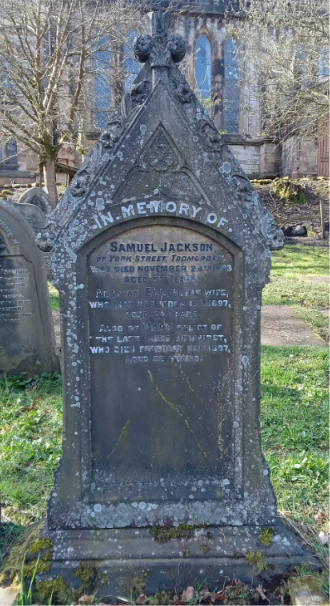
Luke, after all, was a man with a family and a son named after him who would also become a publican; so it stands to reason he had a wife. Mary Sutcliffe was born in Erringden in about 1803, by all accounts to weaver John Sutcliffe and his wife Betty. She married Luke (then only a weaver) in Heptonstall in March 1825 and would give birth to seven children between 1826 and 1845. The couple’s second, Ellen, is the main child of interest here. The Dewhirsts lived first at Lobb Mill, running a beerhouse at Springside, before moving to Gauxholme. Mary kept house while Ellen helped her father at the bar, with occupation on the 1851 Census given as bar maid. You wouldn’t be surprised if she married into the business, but as it went, the business married into her.
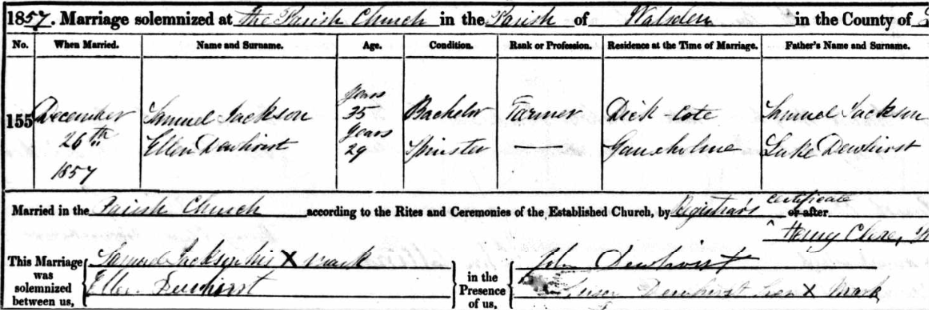
Samuel Jackson was a farmer, from a line of farmers before him, who came from the Pot Oven/Thornsgreese area. We have quite a few Jacksons here in the yard who trace their lines back to this family! This Samuel was working as a carter and farmer when he met Ellen, possibly while bringing coal to the Navigation from the mines up at Inchfield…maybe some other way…but met they did, and in 1857 they were married at Walsden St. Peter’s, with Ellen’s brother John and his wife Susey as witnesses.
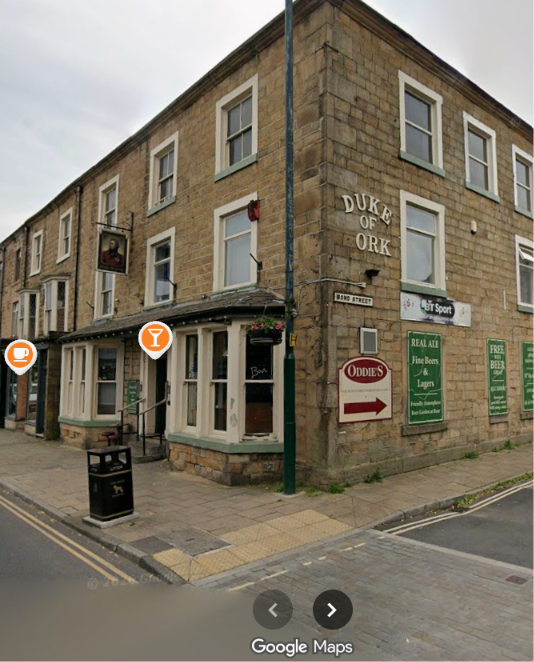
Whose idea was it for Samuel to become part of the family’s trade? Good question. Samuel did so wholeheartedly though and by 1861 he and Ellen were running the York Hotel, aka the Duke of York (or the Duke of Ork, as Google Maps currently shows it).
In an age of pub landlords often being tenants, and the prices they’re tied into paying leading to high turnover and often closures, we forget that once upon a time being a publican was a lucrative business. If offered the opportunity to get into the business – especially if one’s work was historically laborious, dirty or dangerous – who would say no? Samuel was also 12 years Ellen’s senior and would have been glad of the career change for physical health reasons. The couple made a good go of it and in 1861 were able to employ a house servant and a nurse to help look after their little family. They had two children all told, Sam and Sarah.
In 1873 Samuel Jackson died and left his family provided for, but obviously grieving. Ellen buried him here and put up a fine ornate ledger with lead lettering – pure class. Probate on his estate, worth under £3000, had been granted to her. She had the license transferred into her name and continued running the York with the help of servants and staff. It wasn’t easy, and in 1876 Ellen was actually advertising for someone to take over the running of the York as well as selling some cottages because of her “failing health”. Something must have shifted though because she was still there in 1881.
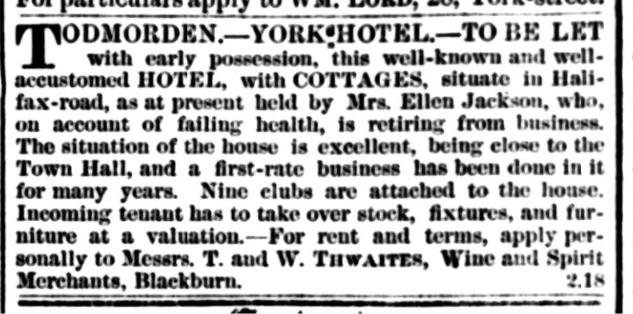
Interesting to note that the rent and terms were determined by Thwaites…back at the start of those dreaded pub landlord tenancies!
Meanwhile, her mother Mary had survived Luke Dewhirst’s death in 1862 and had decided to live on her own rather than with any of her children. On the 1881 Census she can be found living at Stoodley Bridge with a younger female boarder. Mary’s time was winding down though and in February 1887 she died and was buried here with Samuel. Her late husband was buried inside the new St. Thomas’s church in Heptonstall along with his parents, and there was apparently no room there for her. Instead she went to await eternity with her son in law. One hopes they got along in life!
Ellen was now increasingly alone. Sam had trained as an architect’s assistant and gone to Essex with his wife to start a career as an architect and surveyor, and Sarah had married Herbert Lord and moved up to Cliff Villas off Longfield Road to enjoy a little luxury. Ellen had enough money to live on her own means but did she want to? We ask this because poor Ellen found herself the victim of an eternal threat to older indviduals living on their own: the dreaded financial scam.
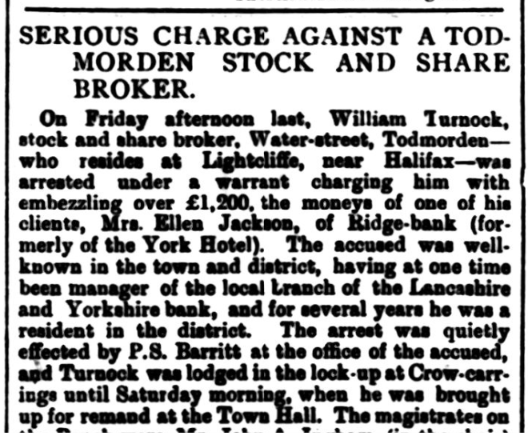
Ellen can be forgiven for trusting this scammer though as he was the former manager of the local branch of the Lancashire and Yorkshire Bank! William Turnock sold shares and stocks from his new office on Water Street and Ellen would no doubt have been wanting to ensure she could live comfortably and independently through the remainder of her retirement. William, however, had overextended his other clients and seen the stocks he had chosen for them lose value unexpectedly, and had begun to run what was amounting to a pyramid scheme as a result. Any losses incurred by other clients were being reimbursed by money coming in from new clients, and Ellen was unfortunately enough to be the final straw that left Turnock unable to manage. Ellen’s £1200 was gone and she wanted reimbursement.
Turnock’s bail was posted by some of his many influential supporters, and shortly before trial he collapsed with peritonitis. Both he and Ellen were overwrought, with Sarah having to attend trial to speak on Ellen’s behalf. In the end Ellen dropped the charges in return for the money to be paid back as and when was possible, but Turnock’s estate was eventually wound up and it was found that he had £1675 in assets and £5929 in liabilities. He hadn’t been lining his pockets with clients’ money, just using it to try and keep all the plates spinning. Ellen wasn’t the only local person stung, either – even wealthy solicitor William Sager was amongst Turnock’s creditors.
In the end we suspect Sam and Sarah financed the rest of Ellen’s retirement, as she was able to keep her house servant of many years Elizabeth Sunderland at her side even after the dust had settled. She died in 1897 at Mount Pleasant, and her estate was valued at a mere £156. Readers; lest we be at risk of sounding flippant, make sure your older relatives don’t put all their financial eggs in one basket. Even a seemingly trustworthy one.