This unusual tomb, one of only two in the graveyard, holds a parent and child – vicar and singer – two figures whose time in this town was relatively brief but who were essential parts of people’s lives here.
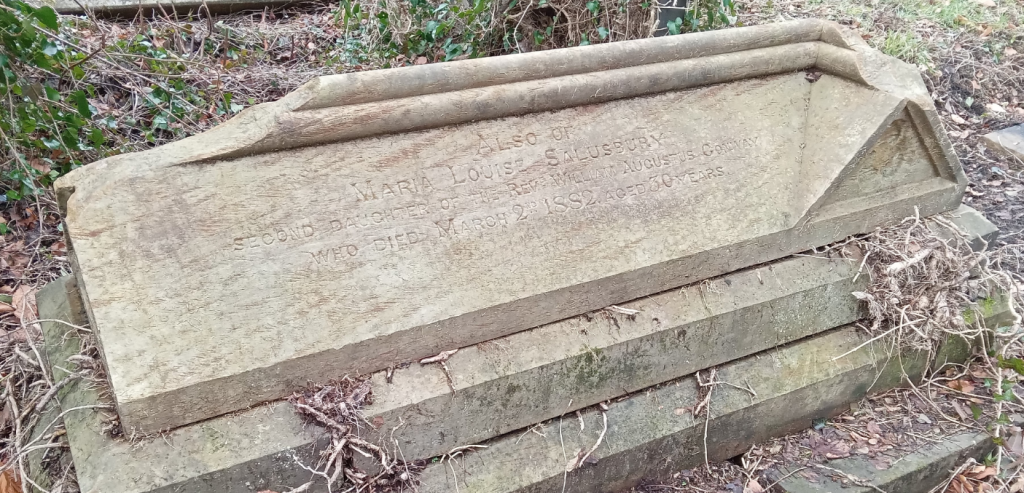
William Augustus Conway was born in West Derby near Liverpool in 1821, one of the children of John Maurice and Mary (Eyes) Conway. John Maurice was a gentleman. Don’t take our word for it, take his – that’s how he’s described on the baptism registers for all of his children! Many of those children had a middle name plus a second middle name of Salusbury, for reasons we don’t know precisely, and this would continue down several more generations. William, though, was “just” William Augustus.
(side note: there was an actor named William Augustus Conway who was popular in London in the early 1820s, who was famously the receipient of romantic letters from the elderly “Mrs Piozzi”, aka Hester Lynch Thrale (Salusbury) Piozzi around that time, but whether there was a familial link to these Conways isn’t clear. The actor William drowned off the coast of the US in 1828, and our William’s eldest brother Edward Salusbury Danvers Conway was born in 1813…so it’s just one of those coincidences, it seems)
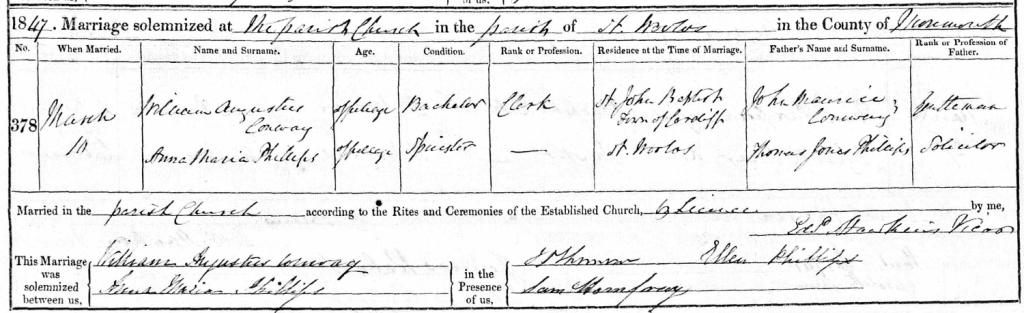
John Maurice died in 1839 but by this time William was already away and entering his career within the Church of England. He became a deacon in 1845, promoted by the Bishop of Llandaff, and was firmly ensconced in Newport in Wales when he met his soon to be wife. Anna Maria Phillips was the daughter of a solicitor, four years William’s elder, and the two immediately started their family with Mary Emilie Salusbury Conway being born in Cardiff about 13 months later. Maria Louise Salusbury Conway was born in Barthomley, Cheshire in 1852, and Marian (or Marianne on her birth certificate) Augusta Salusbury Conway was born in Heywood in 1856. Mary, Maria and Marian…was William high church to the point of being borderline Catholic, or did he want to pay tribute to his mother Mary and wife Anna Maria and then kept going, or did he and Anna Maria simply like the idea of each daughter being almost identically named?
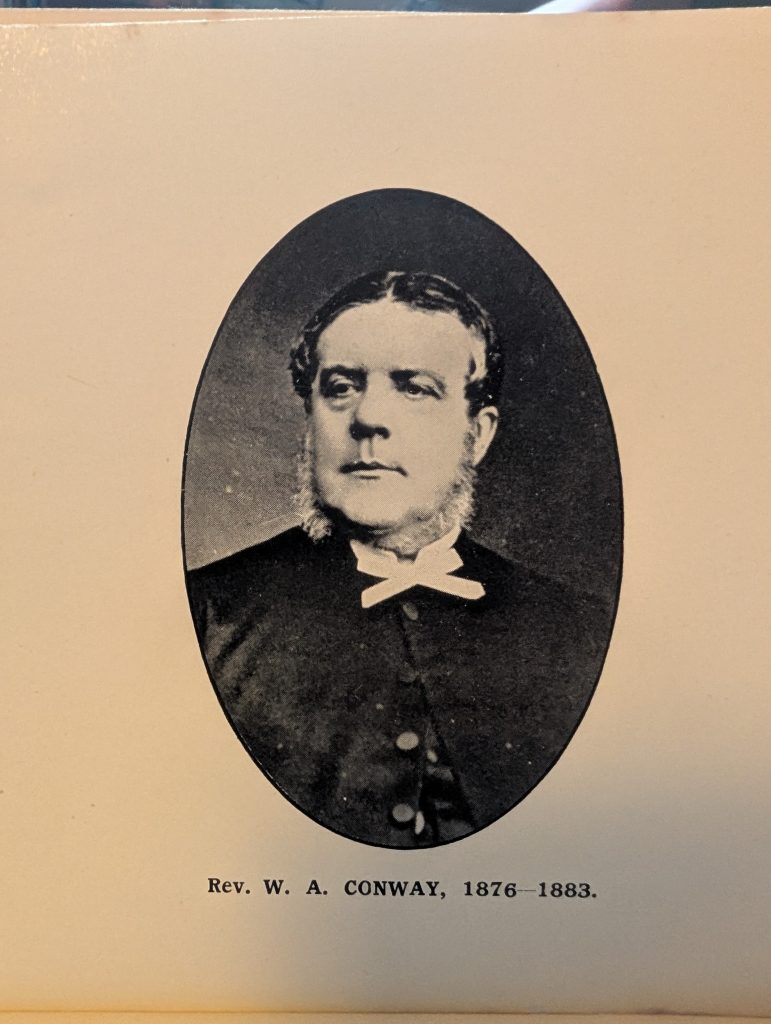
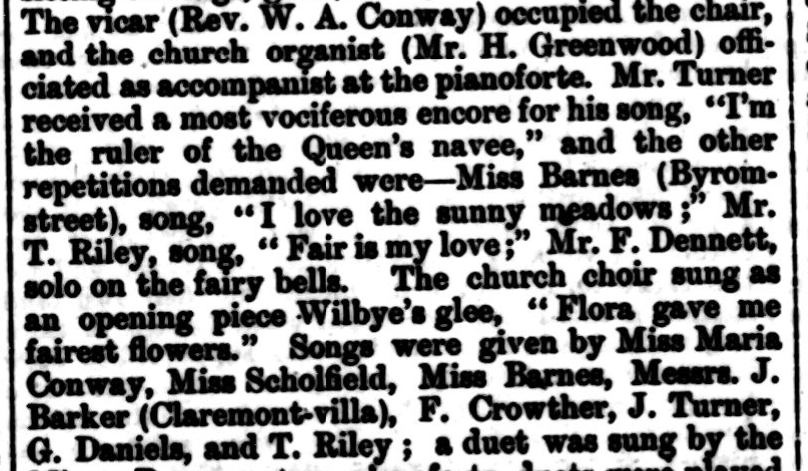
As you can see from the above photo, the Conways came to Todmorden in 1876 to take over from the Molesworth family. They moved into the vicarage next door and threw themselves into the religious life of the town. Unfortunately for William this included becoming party to the continued controversy over which church ought to be the parish church as spearheaded by Thomas Fielden, who had lately come up with a redrawing of the parish’s boundaries in order to realign the population shares across Christ Church, St. Mary’s, Cross Stone and Harley Wood. His daughters had more fun though. All three became involved in the Sunday School, National School, and various other organisations. Maria in particular enjoyed singing and was a regular fixture at fundraisers and parties singing songs for the attendees. This will have been all the more impressive given that Maria had a weak heart. But that’s what a call to service looks like…or what the duties of the vicar’s daughter, which are more important than anything else, look like. Who’s to say?
The parish church debate wasn’t the only controversy William and family had to endure. This is also talked about in Mary Stansfield Ormerod’s story, so go read to find out more, but youngest daughter Marian disgraced herself rather impressively in 1879 after marrying the only son of wealthy manufacturer Abraham Ormerod in 1877 and then cheating on him by committing adultery with the son of one of Todmorden’s former vicars, Lionel Edwards, while he was away on business. The couple divorced and Marian moved back home to the vicarage from her home on Byrom Street. Lionel moved to India. Clearly the relationship meant rather more to her than it had to him. In the meantime though everyone would have been suffering from the public nature of it all. John Howorth Ormerod was not the forgiving sort and had immediately launched proceedings on finding out what had happened, and as the Todmorden Advertiser politely put it,
It is almost unnecessary to say that, since the first intimation given that the petition for divorce was being initiated, there has been a constant current of rumours in the district reflecting on the various parties in the matter,but no doubt the bulk of them have been more or less unfounded or exaggerated.
Oh, well, as long as most of them have been more or less unfounded or exaggerated…that’s all right then! Social media can be a great tool for rumour-mongering, but it’s only a tool – a more efficient delivery method for the message – humans have never been shy about telling others what they know even when they don’t actually know it.
The impact on the Conways isn’t known, and if you merely read the newspapers, you wouldn’t think there was one. No mentions were made of it again. On the 1881 Census it’s William, Anna Maria, and the three daughters at home along with their three house servants. The daughters continued to support local fundraisers and fetes, although Marian is somewhat absent from mentions. Maria is still singing. In 1882, though, Maria’s heart problems caught up with her, and she died at the age of 30.

Her death attracted nothing more than a single line in the deaths notices, with “no cards” at the end.
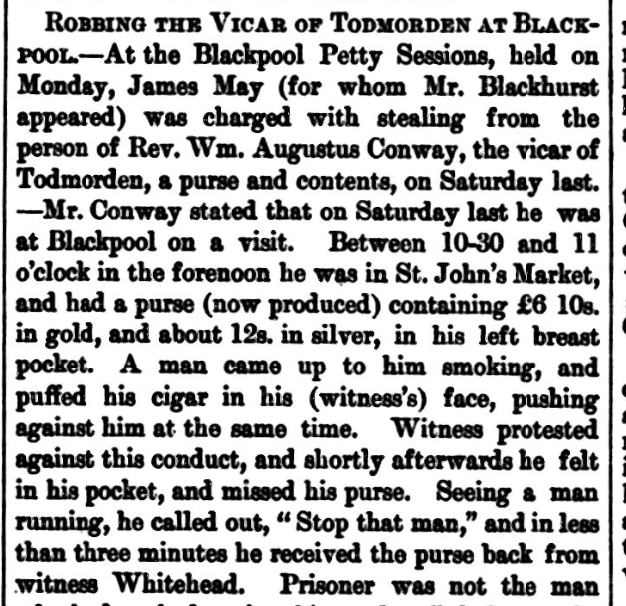
William’s death would be more dramatic. The following year he had some health trouble which seems to have included a small stroke, and in early September he went to visit a friend in Blackpool and take the sea air. Unfortunately, while having a wander through the market, he fell victim to a smoke-blowing pickpocket. His purse was recovered and the culprit arrested and tried, but Conway stayed on a bit longer presumably to recover from overexcitement. On the 20th, as he prepared to return home to Todmorden, he had another attack of “paralysis” which apparently left him unable to speak. On the 23rd he died.
His body was brought home and buried alongside Maria’s, and the funeral was, as usual, impressive. Anna Maria and Mary followed the coffin from the railway station to the vicarage where his body would lie in state for a full day before the day of his funeral. Anna Maria walked behind the coffin with her brother Thomas at her side; then Mary with either a maternal uncle or cousin; then Marian with her new fiance Harry Stanley Parsons. Anna Maria would later pay for a large stone tomb for her husband and daughter, and when she died in 1902 her own name and the date of her death and location of her own burial was added to it. It’s a surprise that she wasn’t buried here, but perhaps circumstances made that impossible. It’s interesting to see that William left an estate behind that was worth £2000, but 20 years later Anna Maria had less than £200 to her name to leave her then only remaining child.
Which remaining child? It would be Mary. Mary, who never appeared in a single newspaper article unless she was subsumed into a general “the Misses Conway”, but who married a vicar in 1887 and seems to have had a settled and comfortable, uncontroversial life. Anna Maria went to live with her and her family and perhaps they were more keen to give away their fortunes than not. Marian, meanwhile, married Harry Parsons and had a family of her own at last, but would die in Belgium in 1896 while on vacation.