Another story about a Lord family dairy farmer – but we aren’t yet sure if William was related to John. Given it’s Todmorden, he probably was!
William Lord was born on August 5th 1842 to Samuel and Hannah (Stansfield) Lord, who are buried at 39.0 not too far away. He was their first baby, born 11 months after their marriage. Samuel was a farmer at High Barn up at the top of Doghouse Lane and life was hard for the Lord children. On the 1851 Census William, aged 8, has “agricultural labourer” as his occupation. But it didn’t put him off; farming was in his blood, and it would be his life.
In 1864 he married Sarah Ogden, who was the middle child of Robert and Mary (Hirst) Ogden, born before her mother’s death and before her father decided to have a dalliance with the neighbour’s wife (you’ll have to read the story to understand!). Sarah would go through three pregnancies in the six years of their marriage, giving William three sons – Richard, Fred and Arthur. Sadly for Sarah, her health failed, and in March 1870 she was buried here. She was only 27 when she died.

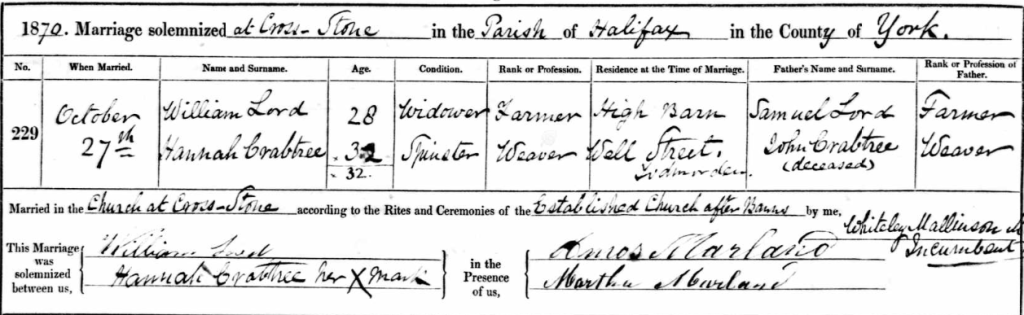
William mourned but he was also practical, and just over six months later he remarried. His new wife was Hannah Crabtree, who was a young woman in a pickle. Hannah’s parents John and Sarah/Sally had both died in the 1840s and left their six children orphans. The eldest was old enough to look after herself but the youngest was only a toddler, and so when eldest child Sarah married gingham weaver Thomas Barker of Hollin Royd in 1850, she brought all her siblings into the household. In both 1851 and 1861 the household is stuffed with Crabtree siblings. Hannah would have thought nothing of marrying a widower four years younger than her who had three children under the age of four…she knew that children without parents needed a lot of luck and tolerance to get by.
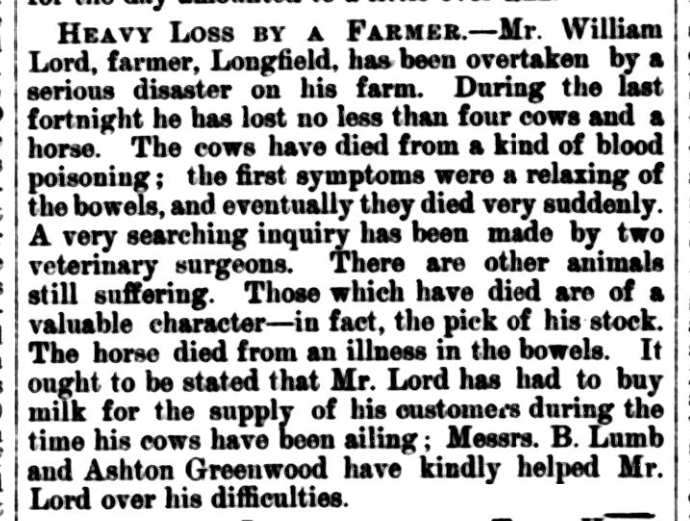
William and Hannah went on to have six children of their own over the next 11 years, and for the most part had good luck. The couple only lost two of their total of nine children – Edgar in 1882 and Edwin in 1887. By 1887 the Lords had moved over the valley to Longfield Farm, presumably after William’s father Samuel’s death in 1883. Here, William would become a dairy farmer, and used his land for not just his own benefit but for that of the Bridge Street Methodist Sunday School’s Whitsuntide celebrations. Groups would come up to the farm and picnic, play cricket, and generally have a sober and responsible good time. Longfield wasn’t all fun and games though…in 1890, William lost a number of his cows and a horse, and was forced to resort to buying milk to supply his customers. Nuisance Inspector Henry Blackburn was put onto the case as William alleged Hey Head Farm was polluting his water supply with fish refuse and nightsoil. The truth was somehow even more disgusting: someone on fields higher up from the farm had buried a horse near a rubble drain, and rats had dragged bits of the carcass into the drain from which water supplied the farm. Still nostalgic for those olden days?
William continued onward though, and expanded his civic engagement to involvement with a “travelling dairy school” which helped train a new generation of dairymen in a mixture of old and new ways of producing milk, butter, cheese, and general husbandry.
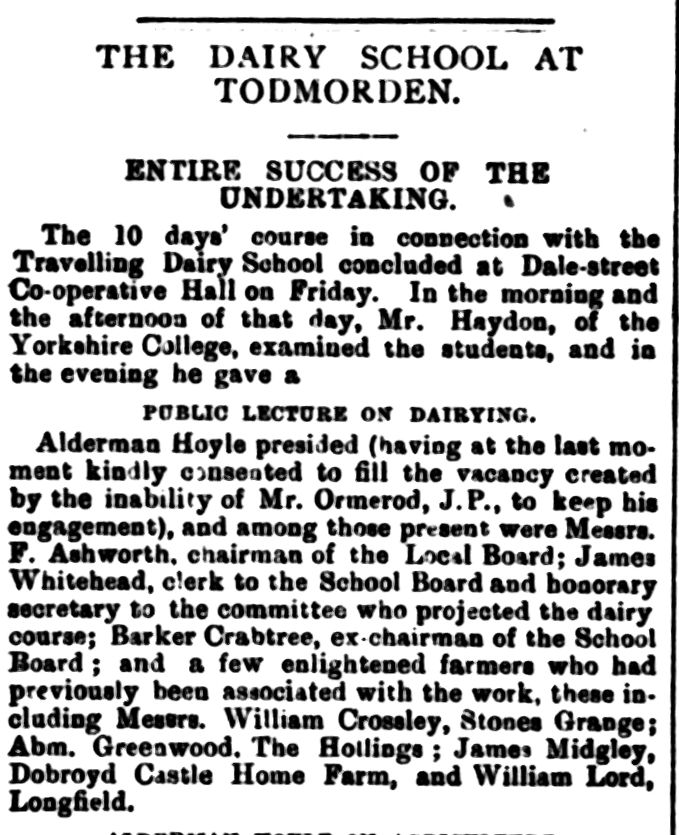
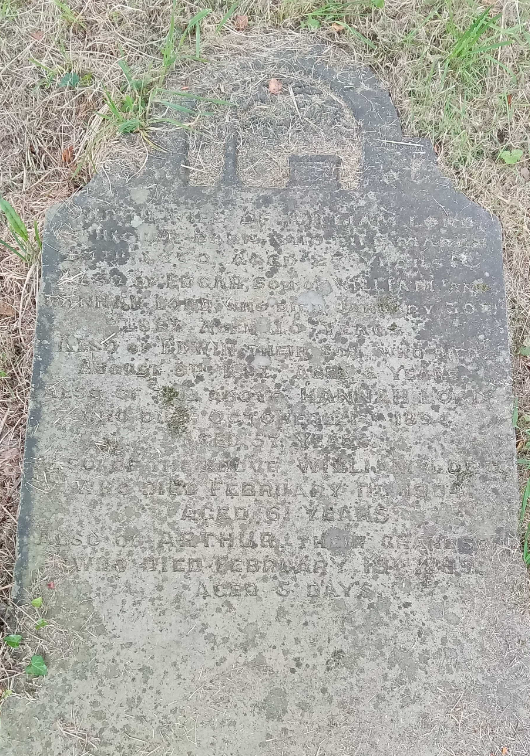
Two days after the publication of the above article mentioning William’s involvement with the school, Hannah died. William retired from farming – she must have been a greater help to him than we would imagine from the record – and moved in with his daughter Sarah and her husband Richard Dugdale on Knowlwood Road. The tops called to him though and by 1904 he was back living with his son Richard on Longfield Terrace, which is where he died that year.
There’s one more name here though, that of Arthur. Not William and Sarah’s son Arthur, but Richard’s youngest son and last of the children he and his wife Alice (nee Helliwell) would have together. His little life was short, only five days long, born and died in February 1898. Richard and Alice were then living at Cambridge Street but it was after this they went up to Longfield Terrace.

Richard’s heart was not in farming but in window washing, and when William died he sold all the dairy stock and equipment at auction and carried on in this very different career as the Borough of Todmorden’s official window cleaner. Makes sense, as his brother Fred became the library’s caretaker. But that was the end of this Lord farming family branch’s adventures in dairy farming. Arthur’s death was also the end of this branch’s burials in Christ Church; this generation of Lords would later all be buried at Lumbutts.