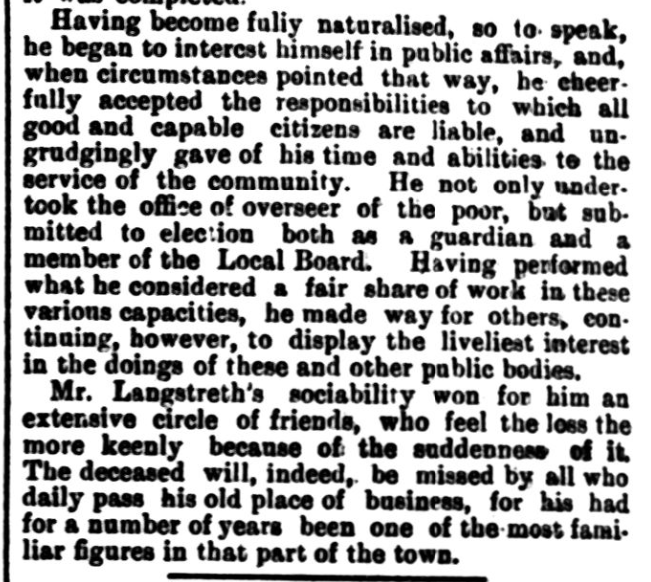
One of these names is that of an offcumden who made a life here, and if you were living in Victorian era Todmorden, you’d have known him well – he had a finger in every meat pie!
Henry Langstreth was born in West Marton, north of Barnoldswick, in 1837. His father Henry was an innkeeper so Henry would have had an interesting childhood; this didn’t translate to him working in a licensed trade or as an ostler, like some other sons of publicans in the yard here, but instead resulted in Henry leaving home to find his way in the world. By 1851 he was living in Bury as a servant, working for the Redfern family. William Redfern was a butcher, and his son James also worked for the family business. Henry saw opportunity and learned the trade too. As was tradition, once he learned he went off to yet again find his way in a strange place, and that’s how he ended up in Todmorden working for butcher Charles Lord at Gauxholme. Todmorden was doing well for itself after all. And despite having no local connections, he was able to make one quickly in the form of Ellen Howorth of Hall Barn at Salford.
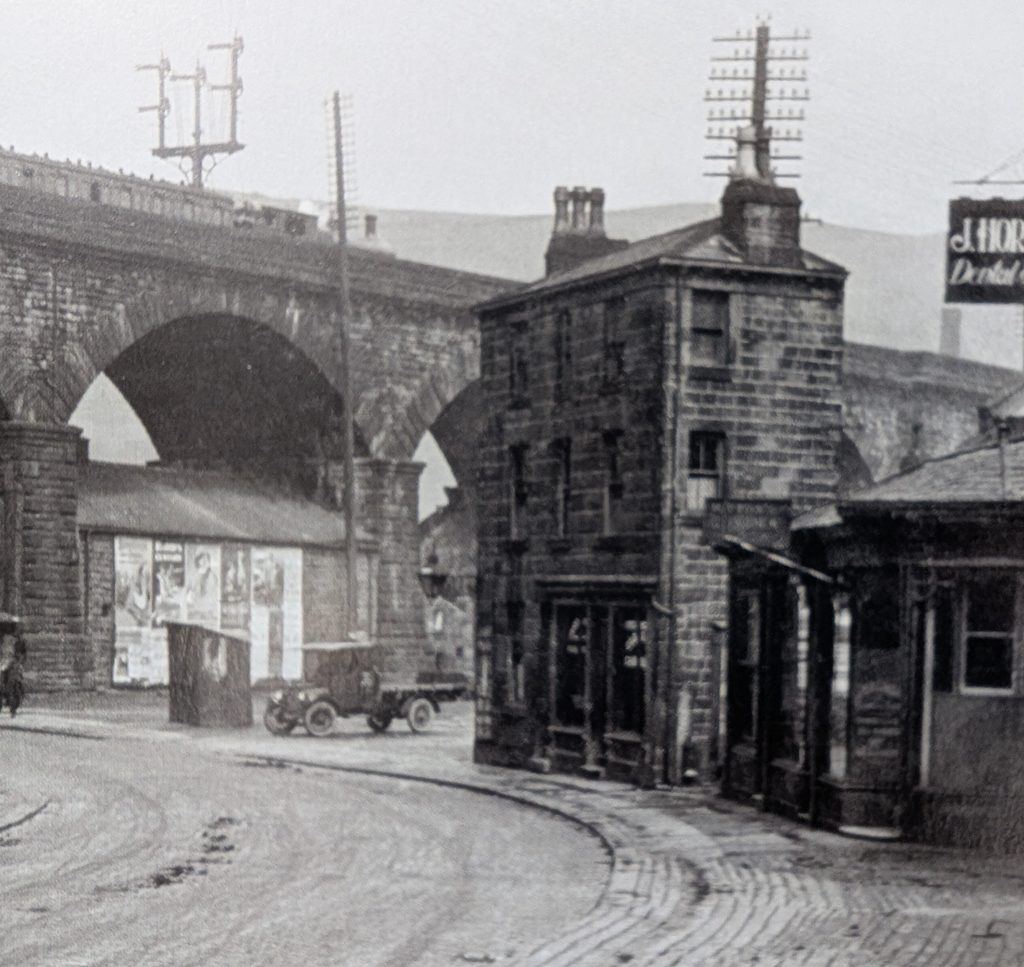
Ellen was three years younger than Henry and her father William was a carrier, the early version of a postman. Hall Barn is on the 1841 Census as being near Timber Yard (the line of shops where Tod Almighty stands now, opposite the Golden Lion) and Todmorden Hall. Ellen had a bigger family than Henry, eight siblings to his five, and lost her mother after the birth of her younger brother William. By 1851 the Howorths were at North Street (Burnley Road) just opposite what later became the Town Hall and was then the market ground. And the market ground was where Henry had also fetched up. Charles Lord had retired a few years earlier and owned some property at Patmos that he sold to Henry on a rent-to-own basis. In 1860 Henry and Ellen were married. The 1861 Census finds them there on North Street with their first son, James Henry.
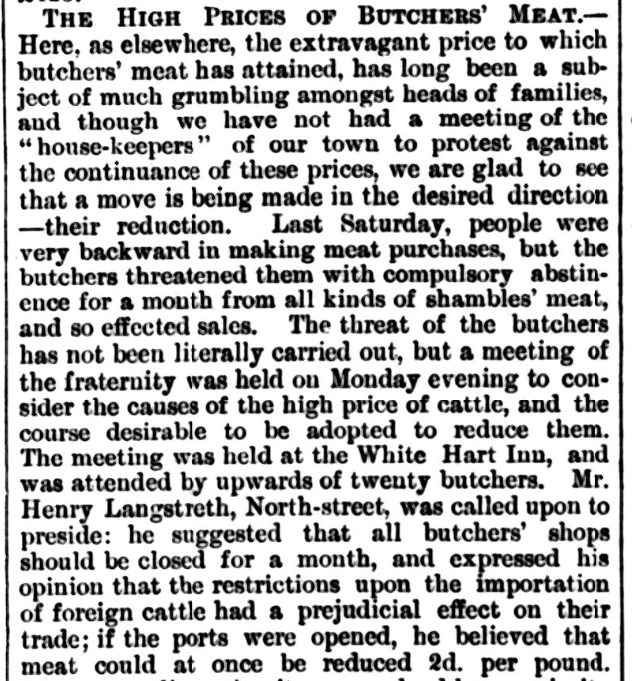
Henry became well known for his meat and also became involved in local society, becoming a confident spokesman for the town’s butchers during various crises around meat prices, joining the Oddfellows, and eventually even becoming a member of the Board of Guardians as an overseer and supporting the Liberal Party. He and Ellen welcomed two more children, Sarah in 1863 and William Howorth in 1865. A problem was lurking though, a problem many faced during Victorian times and which unfortunately is still faced today in some parts of the world…and Henry’s job as a butcher makes the irony of it even worse: tuberculosis.
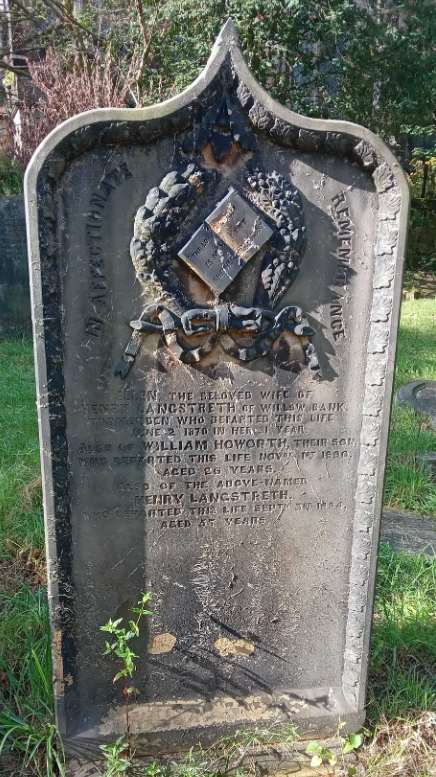
We still hear about “Bovine TB” to this day because of arguments about the best way to prevent it. It doesn’t only matter because it’s fatal to cows though, it matters because tuberculosis is transmittable through meat and milk, something which was beginning to be strongly suspected by the 1880s and almost certain in the 1890s. That’s not to say that it’s the reason it entered the Langstreth home, but it’s just as likely as by any other source. Ellen was the one who caught it first. By this the family were living at Meadow Bottom and it would be there that Ellen died in June 1870.

Ellen wasn’t the only one affected though. William, her youngest, would develop “angular curvature”, a spinal deformity that is linked to tuberculosis infection. It would ultimately cause his death. That’s later though…
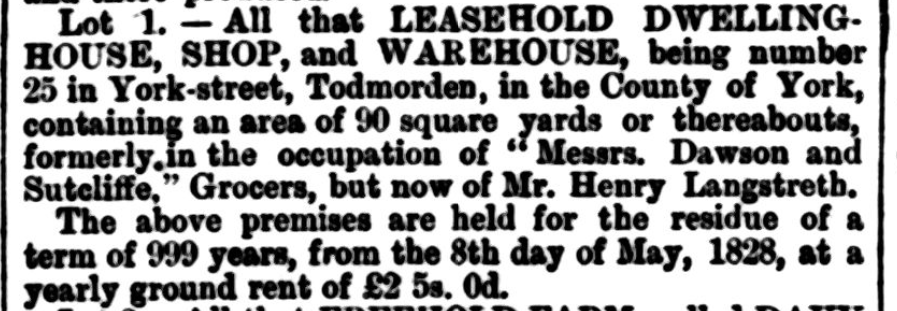
For now, Henry was left with three small children and a growing business and social diary, and of course this meant remarriage. He didn’t remarry straight away though as he was able to afford a servant – Jane Close, who you can see above was the person at Ellen’s side when she died. Jane kept track of the children while Henry worked. A working widow would catch his eye soon though in the form of Harriet Sutcliffe Dawson, a grocer with a shop and home on York Street (Halifax Road) where Morning Glory is now. She had children of her own and was running the business along with her brother Benjamin, and did so well that he too had a servant! There was no marrying up or down here. They were wed in 1873 and blended their families, and Henry moved into 25 York Street. The couple bought 25 when it went up for sale a few years later, then also bought 27, and soon had a shop, home and warehouse to rival any other butcher or grocer in town (although Henry chose to continue to run his own business from the shop at Patmos).
Young William was involved in the grocery side of the business, Langstreth & Dawson, but as we said before, the after-effects of tuberculosis and his spinal problem caught up with him. Angular curvature wasn’t just a pain or movement issue; it also led to abcesses, aneurysms, gangrene, fractures…you get the point. For William the issue ended up being with his breathing and lungs, and in November 1890 he died from phthsis pulmonalis, aka consumption. More irony in that plenty of people without spinal deformities died from this disease…so was it even due to his spine? The doctor thought so at least.

It’s interesting that after William’s death, Henry ceases to be mentioned in the newspapers for any reason other than his service as a juror at Clara Law’s inquest, or as a stockist of Brook’s Dandelion Coffee. His active social career, or at least the public one, was over. He died suddenly in September 1894 from suspected heart failure. His obituary tells the story of someone who was genuinely liked, genuinely wanted to make things better for people around him, and who would be missed.